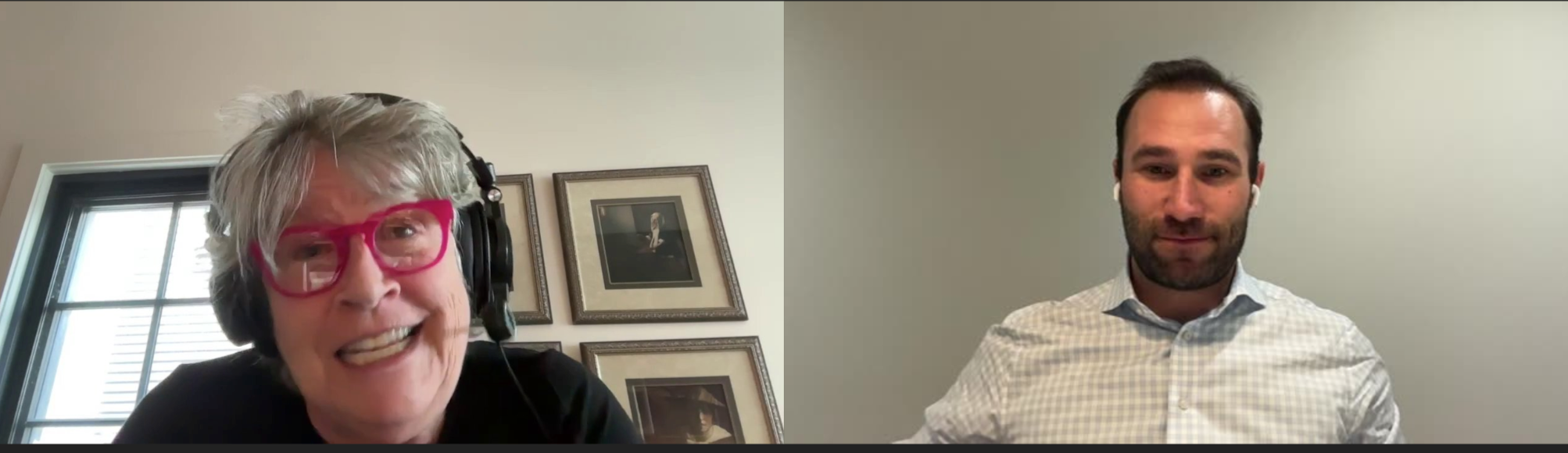


It would be terrible if 5 years from now we wake up and we’re actually more vulnerable and less sovereign, because our medium-sized businesses have been bought up from underneath us.— Matthew Mendelsohn
Though the State of Canada’s Cities Summit is today’s main event at CUI, another event last Thursday, the latest federal budget, is sure to play a large part in panel discussions.
To get warmed up, Mary Rowe had a pre-chat about the budget’s potential impacts on local economies with Matthew Mendelsohn, CEO of Social Capital Partners.
Full Podcast
Transcript
Note to readers: This video session was transcribed using auto-transcribing software. Questions or concerns with the transcription can be directed to [email protected] with “transcription” in the subject line.
Mary Rowe: This is City Talk, the podcast presented by the Canadian Urban Institute, or CUI, and I’m Mary Rowe. My work for CUI keeps me both out and about and out of trouble, I hope, mostly. But like most people, I’m rarely in two places at once. However, today, Thursday, November 12th, as this episode of City Talk is popping up across cyberspace and into your computer or phone, I’m engaged in conversations with urbanists, officials, and stakeholders at the State of Canada City Summit at the Rogers Center in Ottawa. You’ll be hearing highlights from this event right here in the coming weeks. But right here, right now, in recorded time and place, it’s actually Monday, November 9th. And joining me for a conversation about another important event, the latest federal budget, is Matthew Mendelsohn, CEO of Social Capital Partners, and no stranger to the halls of government, and perhaps also to being in two places at the same time. Matthew, do you know where you are or where you will be this Thursday, the 12th?
Matthew Mendelsohn: I will be in Ottawa.
Mary Rowe: With me? Well, that’s lucky. We’ll be together. Very good.
Matthew Mendelsohn: If my wife and children let me go, I’m I’m always only where my wife and children let me go.
Mary Rowe: Yes, well, that’s a good thing. And I’m sure that Kirsten lets you go episodically wherever you need to go. Um why don’t you for first of all, with for the City Talk audience benefit, can you just explain what you do, where you work now, and maybe also where you have worked?
Matthew Mendelsohn: So Social Capital Partners has been uh community finance, social finance impact investor for 25 years. We have invested in community bonds and uh affordable housing and community infrastructure and indigenous-owned businesses and all kinds of cool social enterprises and not-for-profits. And at the moment, we are focused on ownership. Who owns the Canadian economy, how we can uh make more of the Canadian economy democratically controlled, controlled by local owner operators, controlled by Canadians, and when our businesses and our economy and our local resources are not owned by people who have a commitment to Canada and well-being, regardless of party or ideology or particular flavor of the day. So that is our main focus now, how we can uh take more control and ownership uh of our local business assets. Uh and as you say, Mary, I’ve had some experience with this. I’ve been uh a deputy minister in Ottawa and a deputy minister in Ontario, and we’ve been involved in economic policy uh to some extent, but economic development policy. Uh and uh I’m, you know, we are blessed at the moment to have this uh wake-up call from the United States that we need to be in more control of our own economic destiny. We need to be more vulnerable, and it’s a great opportunity for all of us to step up and figure out how we’re gonna do that.
Mary Rowe: In a nutshell. There you have it. Um I often say to people, you know, who owns the city? Because I because I’m looking for an answer, which is that we all do, and that it’s no single sectors purview. Um, and you know, our colleague um Zidakog will say, Who owns the economy? And then you’re taking it even further to, I guess, who owns the country, who owns our economic future.
Matthew Mendelsohn: But those questions, who owns the economy, who owns the city, who owns the community, uh, those questions are pretty simple to ask, um, but they lead to so many complex and challenging questions that are at the heart of our political and economic life. Every one of your listeners, regardless of where they live, uh, is aware that at the moment, many baby boom business owners are retiring and they are selling their businesses. And those businesses are often being bought up by foreign investors, not always terrible, but more importantly, many are being bought up by asset managers of various kinds, private equity firms, whose goal is not building long-term value in that business. It is not making sure workers are well taken care of or that there are returns for communities and for the public. Their focus is usually short-term exit, five to seven year exit for a private equity fund. And so they are more extractive. So that is changing the face of Main Streets, uh, and that is going on right now. It is going to accelerate. Uh, and your audience, Mary, and you, you’re both sophisticated. But when I talk about this, sometimes people think about a barber shop or a nail salon, which are part of this, but it’s also really successful medium-sized businesses that employ 100, 200, 300 people that have millions of dollars in revenue, you know, manufacturing drones uh or uh involved in pharmaceuticals, and they’re being bought up. Uh and if at the end of the day, after this period, however long it goes, of madness uh down south, and it may go on forever, uh, but uh uh I presume no end in the immediate future, but there is a seized moment now where people want to be less vulnerable and want to be more sovereign. And it would be terrible if five years from now we wake up and we’re actually more vulnerable and less sovereign because uh our medium-sized business assets have been bought up from underneath us, and they are more and more managed out of London and Texas and uh New York by asset managers rather than owner operators who care about the communities and the workers in which they live. Mr. Tallerico isn’t going to solve this for us in Texas. Well, I just know of one fund in Houston. I should I uh I didn’t I wasn’t picking on anyone in particular.
Mary Rowe: You know, uh it’s interesting your comment about barbershops and nail salons. So, you know, we have a focus, as you know, at CUI on main streets and downtowns. And but really what we’re doing is we’re using those as sort of visual proxies for the embedded economy, an economy that’s rooted in places. They’re gathering spaces. They they are they’re not just financial capital, they’re social capital too. So if you if you take the whole economy and disembody it, I suppose, and make it all on a on a spreadsheet somewhere, balance sheet somewhere, then you lose all the kind of co-creation, community problem solving, and why we live in community with each other in the first place is to be adjacent to one another, have proximity to one another. So I always worry that we tend to trivialize uh the main street economy as something that’s sort of, you know, kind of nice to have or nostalgia versus essential to the fabric of democracy.
Matthew Mendelsohn: I I agree 100%. And I wasn’t uh being dismissive of small Main Street businesses, I was just highlighting that there have been bureaucrats and political people I have spoken to who, when I raise the issue of ownership and consolidation and turnover, say, yeah, bus uh barbershops are important, but we’re not really worried so much about that. And A, they should be. But B, I want to highlight when we are talking about who owns this, it isn’t only Main Street businesses, it is also medium-sized businesses employing hundreds of people.
Mary Rowe: But you know, when you talk about private equity, when we started MyMainStreet a couple of years ago and we started to get the data to see who bus what businesses were on Main Streets across the country, we started to see more and more personal services. So dentists, um, physiotherapists, pharmacists, things like that. You know, as you say, it’s not just a bookstore or a barbershop. And uh the ones, those are the kinds of businesses that are absolutely vulnerable to this kind of private equity accumulation. I I remember here where I live, uh in downtown Toronto, how far I had to go to find a vet that hadn’t been bought up by private equity. Uh it was because I realized the one I was at suddenly had a thousand vets, and suddenly on the voice, when you’re on hold waiting, I started to hear these American accents trying to upsell me on various products, and I thought, what the heck’s going on? Even though the clinic name hadn’t changed and all that kind of stuff.
Matthew Mendelsohn: Yeah, so so can can yeah, go. Uh the consolidation of professional businesses and service businesses is taking place. It’s bad for consumers, it raises prices, uh, it’s anti-capitalist. It creates high barriers of entry for new uh entrepreneurs and new people who want to enter that. Uh, consolidated markets are not good for workers. It gives them less choice. Um, but it makes it really hard for young people to say, I’m gonna start a business when you are trying to enter a consolidated market against uh, you know, a big fund that has billions of dollars of assets. So it is it is a big problem. It’s a wealth inequality problem as well, because people can’t start their own businesses. And you are 100% right that local ownership, uh, a mid-sized business that employs several hundred people, is 100% connected to the local supply chain. Um, and it builds an ecosystem of vibrant businesses and networks and relationships and senses of human obligation and civic engagement. Your point about democracy uh there is huge evidence in the US that when uh you know Walmarts come in and uh all of the small stores close, it’s not just bad for wages, um, but it is also bad for civic engagement. It is bad for democracy. People vote less, people speak to people less. So all of these things are intertwined. And the work you’re doing on vibrant main streets is the work of not just community and not just economy, but also democracy.
Mary Rowe: Can we talk about when I’m trying to figure out when we started talking so much about investment? When did it become a thing that we don’t have enough investment in Canada? When you look at the Prime Minister’s focus on attracting investment and I actually remember I was working in the 80s when the Mulroney government tried started attracting foreign investment. I remember and I actually worked on it. It was early in my career, and I actually was dispatched and I went out to some of the uh Canadian embassies in Europe and I started talking to people about how you could invest in Canada. But it seems to now just become it’s just become kind of assumed that we have to attract foreign investment to build our own economy. Just help me on that. Like when did this sort of become the totally accepted notion? And and is it still?
Matthew Mendelsohn: I mean, it’s a great question. And uh I I have some concerns about uh that framing. I believe we have enormous capital within Canada and that we could be mobilizing and catalyzing our own investment capital. We don’t have to be uh in the Middle East or in Asia attracting investment. Uh, you know, I guess it’s useful to be diversified, it’s useful to be connected globally, it’s useful to have networks and relationships around the world and for people to have uh an interest in Canada’s well-being. Uh, but there is no doubt uh our pension funds uh could be investing more in Canadian assets, in Canadian mid-size businesses. Uh, they will say some version of, well, if there was something good to invest in, we would invest in it. But that’s not really how it works. Uh first, they organize themselves around asset classes and hire people to focus on specific kinds of things. Their focus has not been on finding investable things in Canada. Uh and also the federal government, if we wanted, could incentivize investment in Canada, could inject concessionary capital. That’s what they’re doing in the venture fund. It’s in theory what they’re doing in uh the mid-size vulnerable manufacturing fund, which the details of which have not been announced yet. But the federal government saying we’ll put in a few hundred million dollars into these funds if the pension funds are putting money in as well. And our capital will be at risk, will be the first loss. So it makes it really easy for them to invest in Canada if they choose. There is a whole parallel agenda that this government has yet to engage with that I think is a problem, which is around how we catalyze philanthropic, retail, local capital, mission-oriented capital. There are billions of dollars of impact investors. Uh, there are many Canadians, there are many smaller pension funds who say, I don’t want to invest in American equities, but I would love to invest in a daycare center or uh local sustainable grocery stores in my neighborhood. Um, and I don’t need 15% annual returns. Um and I want to put my money into that. There wasn’t much talk about that in the budget last week, uh, but we are hopeful that there will be talk about it in the spring economic statement. Uh, and uh in the government is at least aware that they need to start talking about local investment um in things that matter to people’s lives and that will help people every day, because pipelines and ports will not, most people will not see direct benefits, and the benefits that occur are many years away.
Mary Rowe: And at as you just suggested in the budget last week, uh, I know you were hopeful that there would have been some kind of recognition of this. And in particular, you at SCP have been strong, strong advocates of Canada taking a similar kind of uh structural crack at this that the US did by creating community development financial institutions, also known as CDFIs. Do you want to just chat a bit about that, about why you think that approach would be effective here?
Matthew Mendelsohn: So uh I I think that uh it’s pretty clear to anyone who studies Canada’s uh enterprise financing system uh that our big banks are good at what they do, they’re very stable, they are trusted, uh, they are globally recognized, uh, but so much of our business financing is tied to the banks. And the banks, God love them, um, there are certain kinds of things they aren’t well designed to do. Um, in the United States, in Britain, uh, they have been much more focused on cultivating an ecosystem of regional development banks that cultivate their own markets. Some might focus on food businesses in British Columbia, some might focus on uh black-owned businesses in Detroit. Um they will cultivate a market and expertise and figure out the risk profile, and they will lend smaller amounts, and they are not accountable to shareholders. Um, our banks are accountable to shareholders and have really strict expectations around returns. Um, there are a whole bunch of other kinds of financial institutions that are real and viable and work in Germany and France and Britain and South Korea and Japan that are different. And they’re not communist. They are accountable to different goals. They might be accountable to shareholders, they might be accountable to a public mandate, they might be accountable to a particular community or a policy objective. Uh, and we just don’t have many of those. Quebec has built up something real there with Le Chantier and l’économie sociale and their legislation, um, and Desjardins, which understands social enterprises and smaller businesses and co-ops and is much more willing to finance and lend and partner uh on different projects. Uh, and we need to kind of scale that and build that in Canada, and that requires legislation. Uh, because at the end of the day, uh investors are not going to write big checks to small local loan funds that are not properly regulated or accredited. There needs to be some regulatory structure to uh so that indigenous financial institutions, community futures networks, local loan funds uh can attract more capital and lend locally.
Mary Rowe: You know, uh at the risk of sounding like AI that can seems to only be able to communicate in these kind of dichotomous statements. It’s not this, it’s that. Um, what you may be saying is that this isn’t a capital problem, it’s a distribution problem. I mean, we this is what I sort of struggle with because we do have infrastructure to get money into smaller increments into smaller businesses. There are its credit unions exist. Um the their community futures offices exist. Um you know what I mean? Like, do we have to actually create new infrastructure for this? As you say, I hear about legislation, but but the idea be that to be that are do we have other mechanisms? Could municipal governments be empowered differently? Could we to get to get the money distributed into these smaller increments? We’ve run an intermediary program ourselves, so we know that businesses, you know, sometimes they just need 10,000 bucks, and that boosts their inventory and then allows them to do whatever it is that they need to do, and then they can return it at least threefold, sometimes more. But to get that little to the transaction cost for a bank to consider that is non-existent. So do we need new infrastructure to do this, or can we just take some of the what we already have and just empower them differently?
Matthew Mendelsohn: It’s it’s a great question. I think we do need uh new infrastructure, but the points you make are perfectly valid. So there are a variety of restrictions on credit unions that they’ve been arguing uh should be uh removed. It’s not an area of deep expertise on on my part, so I won’t speak to that. But credit unions in some ways have lots of the restrictions that banks have. We could uh certainly capitalize community futures networks better. Uh the budget last week announced that the regional development agencies were gonna have more flexibility uh to do uh smaller programs. Uh, it’s a sentence in the budget, so who knows what that means. But if that meant capitalizing smaller loan funds, um doing smaller loans, like all of that could be good. But my take is that credit unions and regional development agencies and community futures networks are all imperfect and constrained. And we should have a legislative structure that allows entrepreneurs and the market to do its work so that people can um start a new financing agency in my neighborhood right here and say, I am I am going to invest in local businesses. Here’s our governance structure, we are trying to take money in and start a fund and see what happens. Um, your observation earlier uh about investment. Uh, I think that we are at a time when we need to think creatively about how we get capital to more people and more communities and more enterprises. But there are those now. Like there are people making loans in local communities in all kinds of ways. And if we want them to scale and really de-risk, we need to have an accreditation process and a registry so that a philanthropic foundation that wants to write a big check for um building supportive housing in uh Winnipeg can look and see who is doing this kind of work and who has financing uh and who has expertise and who has done it before rather than starting from scratch.
Mary Rowe: You know, religious communities have been doing this for millennia. Right? I mean, the Mennonites continue to. When I lived in Grey County, nobody, none of those businesses were going to the banks. They were going to the farmer for farms over, who was Mennonite, who had a stash of cash and underwrote. And we’re not talking necessarily even just small amounts.
Matthew Mendelsohn: 100%. It I mean, community bonds, informal networks, um, often referred to as the lady bankers, the Roscas, the informal networks.
Mary Rowe: Do they do they call them the lady bankers? I didn’t know.
Matthew Mendelsohn: There’s a book called The Lady Bankers by a professor here at University of Toronto who looks about the informal networks of mostly women in different ethnic national communities who make small loans to people who need $1,000 or $2,000 for various things. So you are of course right, Mary, that there are all kinds of ways that we have financed good works. So it’s about taking all that good, those principles that are in those examples that you’re talking about and making them work in a country like Canada.
Mary Rowe: How does this square with your years of advocacy and research and work on industrial policy? What does an industrial policy look like? That actually sees this local economy as part of an industrial policy.
Matthew Mendelsohn: It’s a great question. Industrial policy is now the flavor of the month. And people who three years ago would have no interest in the state or government being involved in shaping or steering an economy have now become seized with this issue. Maybe that’s which is which is good, but it’s complex. And it is about financing, it is about procurement, it is about public assets and how we deploy public assets. It is about uh repurposing uh existing assets. But to me, a sophisticated, well-functioning economy that has a state that is engaged in industrial strategy uh needs really vibrant, healthy local communities and community businesses that are that are feeding in to the supply chain that are providing services to larger businesses that are part of the industrial strategy. Those are pathways for people for economic security and a decent life and building equity in their business.
Mary Rowe: Um just as we finish, Matthew, you have worked, you’re one of the rare ones actually who’s worked both provincially and federally. And uh this prime minister strikes me as a fairly uh traditional kind of federalist, uh, seeing the provinces as being critical uh to making the federation work. And you can see that in terms of how he’s approaching housing. And I’m wondering in terms of the the area where you’re so doubly focused now at SCP, do you see an opening for provinces to get more engaged? And have you seen any signs of that? Well, you just mentioned BC. Any others?
Matthew Mendelsohn: So I think uh if we are speaking particularly about uh who owns the economy, how it is owned, and thinking about the silver tsunami of retiring business owners and who’s gonna buy those businesses and for what purpose, um, are they uh new young entrepreneurs who are interested in uh growing and building a business and operating it, which is great. But are they new young entrepreneurs who are also interested in employee ownership? Um that’s also great. So having a diversity of different models, and I do think the provinces are seized uh with this, and it uh and it manifests in all kinds of different ways. So some provinces are really concerned about uh the closing of uh rural businesses, sometimes the only business like that in the area with one employee who has run the business for a very long time and no one locally wants to take it over. I know Newfoundland and Labrador are doing an experiment where uh they are facilitating public purchase of key economic assets. By key economic asset, I mean like the one hardware store in the place that uh that would then be community-owned and run by uh the local government. Uh and so different provinces are concerned about different things. I know uh in Manitoba they’ve been very interested in alternative ownership, employee ownership, uh, purpose-driven ownership of various kinds. There’s a you know, a burgeoning movement of um business transitions that are focused on uh ownership that delivers multiple value, not just financial returns, that bakes purpose or that bakes sustainability uh or that bakes mandate into the sale transfer, the federal government through Business Development Canada.
Mary Rowe: Now soon to be merging with Export Development Canada.
Matthew Mendelsohn: Right, which is a huge opportunity, and I hope people are seized with that. Like having a real public bank, the messaging in the budget that says uh we need a public development bank that is focused on public policy objectives, like that is a huge step. And so uh the next year as that gets rolled out is going to be very important. Um, but uh BDC, you know, has a program for women entrepreneurs to buy businesses, so kind of a search fund model if people know what a search fund is, but also for Indigenous uh businesses. BDC has a program where uh you know making it easier to sell a business to a community. You don’t usually think about a collective or community purchase of that business, but uh that’s to acknowledge community ownership and collective ownership of economic assets in Indigenous communities. And that’s a super cool thing. So let a thousand let a thousand flowers bloom.
Mary Rowe: On that happy note, I’m gonna see you lots this week. And we’re gonna be talking with a lot of those flowers that are blooming. So thank you, Matthew, for coming onto City Talk. I look forward to uh our shared, hopeful expectation of the details that we’ll see in the spring economic statement and all the important things that will happen between now and then. So thank you for being uh such a provocative um conversation at City Talk.
Matthew Mendelsohn: You too, Mary. Thank you. It’s been a pleasure.
Mary Rowe: There are clearly advantages to being able to be in two places at once. And I would like to thank all the people who are making it happen this week, primarily the sponsors and supporters of CUI, State of Canada Cities Summit, beginning with RBC, our presenting sponsor, and then our key partner, the University of Toronto School of Cities. We’re also uh very, very excited to have so many other additional sponsors. And if you go to the Summit website, you can see a long, long list of them. And thank you to all our partners and sponsors and staff, because I think on Friday we’re in 11 different venues uh working on a variety of topics there. All of this content will be packaged up and sent out to City Talk listeners in different kinds of formats so that if you’re not able to be in Ottawa, you can still hear about it and learn as we are going to all the fabulous ways that people are actually making things work in their communities and cities across the country. So, with the federal budget behind us, a spring economic statement ahead of us, it’s still a time of extraordinary turmoil and transition for Canada. We look forward to you joining us on subsequent broadcasts where we’re going to continue to talk about what’s working, what’s not, and what’s next. And at the summit this week, we are announcing some important initiatives, including the Main Street Economy Index called the MSE 100, talking about the real economy, a transformation framework for the future of housing in Canada. We’re also profiling this week at the summit a report we’ve been working on for some time on downtowns, which we think we’ll call the downtown difference, a national picture of how our downtowns are doing to work in tandem with how our main streets are doing. We’ve also got the city managers from across the country talking about how they navigate these extraordinary transitions. And of course, what would a program be without something on AI? We’ll be talking about AI and we’re going to be talking about accessibility. These are all important things to be considering as we build our cities for the future. So thank you for joining us. Drop us a line at citytalk at canurb.org or use the Talk to Us from Your City link under the podcast description to send us an instant text or video message. Oh, and thanks to Andre La Riviera of Purple Pro Solutions for producing this podcast and being with us in Ottawa to produce much more for you coming soon. I’m Mary Rowe. Thanks for listening.