

Summary
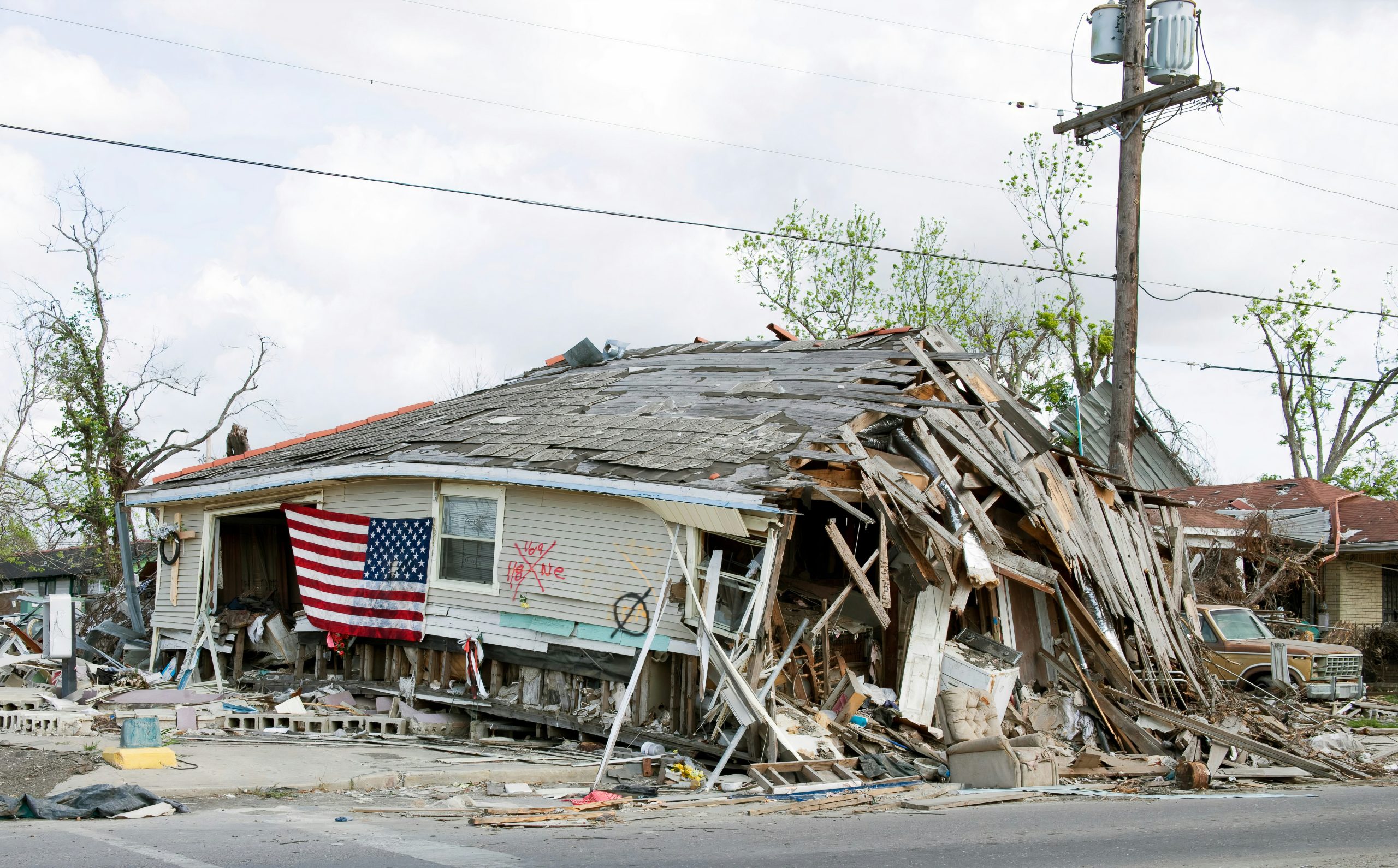
This week marks the 20th anniversary of the floods that devastated New Orleans when Hurricane Katrina struck. In many ways, New Orleans gave us a preview of what other cities would come up against in the face of climate disaster.
Host Mary Rowe witnessed the destruction and recovery efforts firsthand. She is joined by two other Katrina watchers who were in New Orleans then, to talk about what lessons other cities can learn from that time.
Allison Plyer is the chief demographer at The Data Center, who created The New Orleans Index in partnership with the Brookings Institution, which tracks the city’s recovery efforts.
Andre Perry is a senior fellow with Brookings and the director of The Center for Community Uplift, and the author of books such as Black Power Scorecard and Know Your Price.
Further reading: “How resilient is New Orleans Today” at The Brookings Institution.
Photo by Library of Congress on Unsplash



Full Podcast
Transcript
Note to readers: This video session was transcribed using auto-transcribing software. Questions or concerns with the transcription can be directed to communications@canurb.org with “transcription” in the subject line.
Mary Rowe: [00:00:02] Welcome to City Talk, the show about what’s working, what’s not, and what’s next for the places we live. I’m Mary Rowe and I lead the Canadian Urban Institute. [00:00:10][7.6]
Andre Perry: [00:00:13] Oftentimes when we frame things as what’s going on in New Orleans, has New Orleans improved, if you don’t put it in the national context, it ultimately leads to blaming local leaders or people for what they did not do, when in fact they’ve done a lot. But guess what? The climate is changing underneath it. [00:00:33][20.7]
Mary Rowe: [00:00:37] Twenty years ago this month, a hurricane landed along the Gulf Coast of the United States, making Katrina a household name for millions of Americans. It was really the most massive weather event to hit here in North America in a century, and became a kind of precursor to what we now have become much more acclimated to. I was just starting that week a fellowship with the U.S.-based charitable foundation, the Blue Moon Fund, whose wealth had been derived decades earlier from the oil business in Louisiana. So I was swiftly dispatched to the region with which I had absolutely no familiarity. What then began for me was a deep learning journey about climate, landscape, culture, inequality, race, and the extraordinary, but clearly not unique, systems failures across all forms of infrastructure. Flood protection, housing, education, social services, mobility. I worked and lived there for the next five years, watching carefully how the local New Orleanian community survived another inundation, This time from experts. Coming from all over the world with a mission to fix New Orleans. It was an intense, immersive course in the power of place and people’s stubborn and inspired attachment to it. Before 2005, few knew the term resilience. The capacity to recover from a shock and return to what was, or maybe something better. Now, building resilience to whatever the threat may be is everyone’s new normal. So here in the summer of 2025, as most of us breathe smokier airs and have a go bag packed nearby, I am very pleased to welcome two veteran Katrina watchers, who are with me embedded in the fibers of that city during that period of time, and have gone on to leverage their learnings for not only New Orleans and the Gulf Coast, but nationally and internationally. Allison Plyer is the chief demographer of The Data Center in Southern Louisiana. She created and authored the annual New Orleans Index, which was created shortly after Katrina in partnership with the Brookings Institution to track progress. Andre Perry is a senior fellow with Brookings and the director of The Center for Community Uplift. Both Allison and Andre are published authors and frequent media commentators, so you can imagine this is not exactly a quiet month for them. I’m very grateful that they’re coming to give us today a bit of their time. Hi there. [00:02:58][141.4]
Allison Plyer: [00:02:59] Hey Mary. [00:02:59][0.1]
Andre Perry: [00:02:59] Hey Mary! [00:03:00][0.3]
Mary Rowe: [00:03:00] You hanging in there? [00:03:01][0.6]
Andre Perry: [00:03:02] Yes, it’s been a while. We haven’t seen each other in a minute. You crossed the border. [00:03:06][3.5]
Mary Rowe: [00:03:06] I did, I did. But I’m never far away from you. What can I say? And you know, from the time that I was in New Orleans, I started to refer to it as a prophetic city, both positive and negative aspects of that. So I want us to start by you telling us, why does New Orleans matter? Why does the experience that it’s been through in the last 20 years that you’ve been witness to, why does that matter? Allison, first to you and then to Andre. [00:03:31][24.8]
Allison Plyer: [00:03:31] Oh my goodness, wow. Well, as we said at the time, New Orleans was the canary in the coal mine. And it’s not been fun to be right about that, but we’ve been right about that. Right? And so we see these major climate shocks happening all over the world. And New Orleans is not the only vulnerable place. So really helping places like New Orleans be resilient is really critical for the rest of the world to understand how they can be resilient. [00:03:59][27.4]
Mary Rowe: [00:04:00] Yeah, I mean, nobody really used the term resilient even then. Sustainability was more the term that people used, but somehow that didn’t work in this particular context. We seemed to quickly move to resilience. Andre, tell us why you think neurons matters. You live in DC now, but you were a neurons, right, with us at that point. [00:04:15][15.8]
Andre Perry: [00:04:16] I mean, one, the New Orleans story is part of the American story. We kind of talk about culture loosely and its importance in this country, but when you’re talking about music, food, multicultural communities, diversity, all of that kind of started in New Orleans. You know, and we kind gloss over the fact and then use the metaphor a little bit too much how new Orleans is a gumbo of different things, but it’s true that when you’re talking about people of African descent, the French, eventually English, you’re talking about folks coming from all over the world. You’re also talking about a place that had one of the largest slave ports in the country. And so how that story goes in New Orleans will dictate how the story goes around the rest of the world, saying that canary in the coal mine, but I can’t say enough, New Orleans matters because people matter. And we’ve seen time and time again during tragedies, not just in New Orleans, but all over the world that sometimes we ignore the most vulnerable, we ignore that dispossessed, we ignore folks who have been disenfranchised, and we miss opportunities to rebuild. And so for us, this represents, 20 years later, represents yet another opportunity to invest in the people and the place of New Orleans, because it will send a message to the rest of the world. [00:05:57][100.5]
Mary Rowe: [00:05:58] Hard to believe it’s been 20 years, eh? Just how that time span has just blown by us. Can you just take me back? Why were you in New Orleans 20 years ago? [00:06:06][8.4]
Andre Perry: [00:06:07] Yeah. I was a bright bushy eyed professor with much longer hair. Imagine me with these long, luxurious locks and I was the professor at the University in New Orleans, came a year before the storm in 2004 and at the time I was just an everyday professor working on educational issues, but obviously the storm arrived and I quickly almost switched from being an education policy person to a recovery person in general. And so I came to New Orleans as a professor, but I became a community member through the work in recovery where we literally were cleaning out schools, finding families, rebuilding the school system in real time. And so, I mean, my life changed dramatically, like, like a lot of people, but I can’t say enough there was such a, it was such an impactful time on my life and other people’s lives. [00:07:15][68.7]
Mary Rowe: [00:07:16] And as you say, my circumstance is somewhat different, but the same kind of feeling, like you were just thrust into it. There was no passive observing. We were all participants. Allison, why were you there? How had you gotten there and why were there? [00:07:29][12.5]
Allison Plyer: [00:07:29] Oh my goodness, I moved to New Orleans in 1998 because of Jazz Fest. [00:07:33][4.3]
Mary Rowe: [00:07:34] Really? Music brought you there? [00:07:35][1.1]
Allison Plyer: [00:07:38] And I was quickly recruited to work at The Data Center, which had just been incubated at Tulane, but was going out of Tulane and really intent on democratizing data and helping average folks access and understand and utilize data in highly usable forms, lay language. So we had all this wonderful data for all 72 New Orleans neighborhoods. And when Katrina hit, suddenly the whole world wanted New Orleans data. And while I was evacuated, I was answering all kinds of media questions and responding to all kinds federal agencies. The Census Bureau was asking me how many people had evacuated. And ultimately we formed some critical partnerships, one being with the Census Bureau and the other being with Brookings and really looking at the recovery over time and helping inform the recovery, what was going well, what is going poorly. So people could get a sense of progress over time and how to prioritize. [00:08:35][56.8]
Mary Rowe: [00:08:36] Yeah, this is one of the prophetic elements I think. There are just these components that had to be quickly invented in New Orleans and now are just part of, I think, the rule book of how you build resilience in the community. But local data, Allison, I mean, you had some fights to convince authorities that your data was actually the most reliable. Can you remind us about that? [00:08:58][22.1]
Allison Plyer: [00:08:58] Yeah, there were a couple of them. One of the big ones was the Census Bureau’s population estimates, which happened annually in 2007 and 2008. We could tell we’re way too low, and we actually convinced them to increase the estimates, all totaled by about 75,000 people. And back then, the city had less than 300,000 in it, so that was a big chunk. When they did the 2010 count, the estimates were within 6% of the actual count. Otherwise, that would have been off by 25%. So it was a big win for the Census Bureau that they had listened to us. [00:09:30][31.5]
Mary Rowe: [00:09:30] So when you look back at that period of time, you were an educator and instantly a community activator. Andrea, I get that. And Allison was there trying to make sure that she was building a material data case. What were the key challenges? And do you remember having to parse priorities? How did you figure out what the challenges were? [00:09:49][18.6]
Andre Perry: [00:09:50] Well, I’ll say this, that while you were trying to help rebuild the city, you were also managing your own life. And so, you know, where are you going to live? How are you gonna pay bills? I remember, you know, not every. Store had carry cash. So you, you were figuring out where can you transact in the real way. So there was a real livability issue, not just in general, but for the folks who are working on these issues. Now I will say housing, if there’s any one thing that was a challenge at the time, it was housing because such a large percentage of the city flooded, you know, and to clean up and then rebuild this. Takes time. And if you can’t get into a home, it’s less likely you’re going to get a job. It’s less like you’re gonna participate in other civic activities. So I would say if there is another priority or challenge, it was around housing. And then finally, I’ll just maybe go on the communal side of this, that so much of New Orleans is about our social connections there. And so I’ll never forget. The first second line back or first second one after the storm, which occurred in January. [00:11:11][81.6]
Mary Rowe: [00:11:12] Andre, explain to people what a second line is. [00:11:14][2.0]
Andre Perry: [00:11:14] A second line, generally it historically is part of a ceremonial ritual in which there is the typical funeral proceeding and then there are the second line that follows that is more celebratory in nature. But second line parades are something that occur on a regular basis in which the celebratory tone, it takes precedent. There’s actually a second line season where revelers from all over the city come together and celebrate around people, around events, you name it. So the first second line back was one of the indicators, I say, of resilience. Because when you can bring back sort of the social aid and pleasure clubs, the other civic organizations that are really core to New Orleans like no other place, then you know you’re on the way back. So you did have this, the physical challenges of living, you had housing. But then there’s the social elements, and all of those things were a challenge initially, in my opinion. [00:12:18][64.0]
Speaker 4: [00:12:18] What do you remember, Allison, as those big challenges, then, at the beginning? [00:12:21][2.8]
Allison Plyer: [00:12:22] I can certainly echo what Andre said. I mean, those of us who were able to come back, I had my job, but my house had flooded. So I was couchsurfing and trying to figure out if I was going to try to rebuild it or what I was gonna do. And there was one Home Depot open for 50 miles. And one grocery store for 50-miles, right, and it had limited hours because there weren’t any people there to staff it. The livability issues were enormous and it felt like some sort of Armageddon scene. And yet. You know, the whole city also was really like a group therapy session constantly, right? With everybody really supporting one another with, how was your day? What’s going on? You know just sharing good information, helping one another, there was so much helping one another. I had probably, you know, three dozen friends at different times come to my house and help me with the mucking out process. And a lot of that, you now, the gospel choir I was in was a big part of that. The social aid and pleasure clubs are real mutual aid groups and they really stepped up. [00:13:18][56.4]
Mary Rowe: [00:13:18] Talk to us about the work you’ve done, because you have, again, partnered with Brookings, Allison, and you’ve, so you’re working with a national institution that has all the resources and credibility of that. And there you are in little old New Orleans trying to surface the key indicators to tell us how’s it worked out? Where are you 20 years later? What are you seeing in those patterns? Is the city more resilient? Is the region more resilient? [00:13:43][24.2]
Allison Plyer: [00:13:43] Well, we looked at all the aspects of resilience, right, and there’s actually really good literature on this. And so it’s not just about strong housing and infrastructure, it’s also about a diverse economy so that if, you know, your one major industry goes down, you can rebound if you have diversity in your economy, meaning sectoral diversity. It’s about wealth, having some cash in the bank, whether it’s a rainy day fund at the government level or philanthropy or individual wealth is absolutely. Critical for disaster recovery. And it’s about social cohesion, right? And all of these really make a huge difference in recovery, attachment to place, that sort of thing. So we looked at all those things. And it’s certainly clear that we need additional investments in stronger infrastructure and housing. Some of that is already happening. We have the best levies in country now. We have extensive work been done in our drainage. And water management that’s been amazing. We need more work on our energy infrastructure, but here again, community is stepping up. We have community lighthouses where churches and community centers have installed solar panels and batteries. So when the power goes out, when we get shocks, folks can go there, get their medical charges, devices charged, have community, all of that. So we need more in terms of housing and infrastructure investments. The economy is diversifying. Entrepreneurship is a huge bright spot, and Andre can say a lot more about that. And wealth is a weak spot, material wealth, of course. We don’t have it much individually or in philanthropy, but social cohesion is an incredible strong spot, and is definitely a big piece of what has helped the community in each of the shocks it’s received to rebound. [00:15:29][105.7]
Mary Rowe: [00:15:31] I think you said lighthouse, every community has a lighthouse. Yes? [00:15:33][2.6]
Allison Plyer: [00:15:34] So, there’s something called community lighthouses. After Hurricane Ida hit us in 2021, the power was out for two weeks in some parts of the area and then four weeks in other parts. And folks realized this is going to happen again. So churches started raising money and other community centers to put up solar panels and batteries, storage batteries, so that they would have power. The minute there was a power outage, the intent is to have one within 15-minute walk of everybody in the whole city. And that is much more achievable than getting every single house its own solar panels and batteries, right? And it also is social cohesion. It brings people together, you get a meal, the adults get to watch the kids, everybody gets to exchange information. It was operationalized during Hurricane Francine and worked beautifully. [00:16:19][45.3]
Mary Rowe: [00:16:20] Andre, I’m interested from your perspective, you’re looking at big macro conditions all the time. Obviously inequality and the racialization of inequality and the rationalization of poverty, it must show up all the time in every piece of work that you do. And in New Orleans, is it more extreme than in other cities or is it sort of typical? [00:16:40][19.9]
Andre Perry: [00:16:41] Well, building off the last response, I’ll say this, that when you’re at Brookings or you’re looking from a national perch, you also realize that New Orleans is not alone. And oftentimes when we frame things as what’s going on in New Orleans, has New Orleans improved, if you don’t put it in the national context, it ultimately leads to blaming local leaders or people for what they did not do when in fact, they’ve done a lot as, as Allison has mentioned in terms of water management, in terms building up the levees, there’s improvement there. But guess what? The climate is changing underneath it. And I say all that to say is that what I’m seeing in New Orleans is. Incredible strength. And Allison mentioned this, I wrote the report on entrepreneurialism in New Orleans. And we’ve seen an increase, particularly in response to the shocks after the storm, of course, but then during and in the aftermath of the pandemic, Now the COVID pandemic, you’ve seen. New Orleanians step up in the face of reduction in services and the like, entrepreneurs fill that gap. And that tells us that people are resilient, that they will respond with the tools that they have. And so I say that to say that we must utilize that strength of entrepreneurialism and invest in it because when you’re looking at these wealth gaps. In New Orleans, which are profound, and particularly for black people in the city. The second most revenue producer of wealth is business development. So we should use that strength to address the other weaknesses in the system. So when, as we’re working with schools, as were working with housing, let’s look to entrepreneurialism and the business leaders in that area. To help build up those areas of weakness. So you leverage your strength to address the weakness. But what’s fascinating about the entrepreneurial space, and I really do mean this, is that for the descendants of the enslaved to now see increases in the share of employer firms, firms with more than one employee, that says something. That says something to the country That when given an opportunity. People will step up. Let’s be clear. People said a lot about stimulus checks and recovery dollars. Guess what people do when they get that access to capital? They start businesses. They respond. It’s not the, oh, there’s waste and, you know, all this other nonsense. People will leverage the resources to build up their families and their communities. And I’ll just add this, this is my own personal thing. We also, this look at things is zero sum. If we invest in one group, we’re taking away from another. No, the way to increase that proverbial pot is to invest in the underappreciated assets in a community, investing in the people who can literally add value in so many different ways. So for me, I’m using any kind of what we perceive as a negative stat or negative information. So how can we see the opportunity here? And the business community is known for taking advantage of opportunities. So let’s leverage the business data that we see, which means leverage the people behind those data to address all these other social problems. [00:20:30][229.6]
Mary Rowe: [00:20:31] It’s interesting, I mean, you know, as you said earlier, Allison, you know Rollins was the canary in the coal mine, you know that old adage, if you get lemons, make lemonade. I mean you are the early adopters of multiple lines of defense, of different kinds of approaches to mutual aid being culturally embedded through social pleasure clubs. All the festivals, we started with Andre talking about the second line, that entrepreneurial kind of creative energy is kind of hardwired into New Orleans it appears, it’s kind of perverse the way that the enabling conditions to spur you have been these remarkable shocks. [00:21:08][36.9]
Allison Plyer: [00:21:09] And the aid that followed. [00:21:10][0.7]
Mary Rowe: [00:21:11] Allison, you’ve got the data to support what Andre is speaking to, that the entrepreneurial energy is evident in the data, is it? [00:21:17][6.8]
Allison Plyer: [00:21:18] Oh yeah, absolutely. So we’re seeing right now that New Orleans rate of business startups is 35% higher than the national average and it’s actually 29% higher than the average of the other 49 largest metros. So it is, it spiked after Katrina and has remained consistently higher than other metros ever since. [00:21:38][19.8]
Mary Rowe: [00:21:39] I remember, with a lot of your colleagues when I was living there, I remember Karen Gadbois saying, you know, we thought for a couple of years the cavalry was coming, then we realized, no, no, we are the ones that we’ve been waiting for, we just had to get up and do it. That kind of realization that you’re going to have to- [00:21:55][16.4]
Andre Perry: [00:21:55] I wouldn’t say it’s a realization as much as people just need the capital. You know, one of my favorite quotes come from Thich Nhat Hanh, you know, if you’re seeing ahead of lettuce and the lettuce isn’t growing, you don’t blame the lettuce. You look to see if the soil’s enriched, if it’s getting sunlight. You look see if it was getting water. You never blame the lettuces. When things go wrong in New Orleans, we blame the lettuce. Right. We blame people. We don’t look at the resources that aren’t there as a reason for not growing. And so for me, whenever we see a lack of growth, you point to a lack of investment. And whenever you see growth, you point the investment. People just want the resources. Let me be clear. It’s not like they’re realizing, oh, I can do this. They’re waiting, they’re ready, folks are ready to work. We’re ready to do these things. They just need the resources to unleash the activity. [00:22:53][57.7]
Mary Rowe: [00:22:54] So let’s talk about sources of investment. Does New Orleans have the sources of investment it needs, both in terms of getting it to this point and also for the future? [00:23:02][8.1]
Allison Plyer: [00:23:03] Yeah, no, I think that’s a really big question and, you know, New Orleans has some of the lowest philanthropic assets per capita of any of the largest 50 metros. And there’s really no doubt that it was external philanthropy, working with local philanthropy that was critical for a lot of the work that got done post Katrina. And so, you, know, that that’s the challenge. You know, the state also is going to have to think differently about its resources. I think that when we look at sort of the opportunities to grow the economy, we really need to be ensuring we’re incentivizing businesses that actually employ people. And more and more of the really large corporations are using automation and mechanization to employ less people. So the state itself has only grown jobs 2% since the year 2000. And the nation has grown 20 percent. And now the state was gaining, regaining, regained population until just a few years ago and now is losing population. And the number one reason people move long distances is for work opportunities, right? So we know that the state really needs to start focusing on the businesses that are newer, that are entrepreneurial, that employ folks. The older industries like oil and gas are more and more productive, meaning they’re hiring fewer people. More drilling, more mechanization. Less hiring, and that’s true with Upstream Chemical, which got billions of investment over the last 20 years and is hiring very few people now, fewer and fewer. [00:24:31][88.0]
Andre Perry: [00:24:31] Well, I mean, this is a thing that United States is not going to be a nation of seven superstar cities where everybody gets the jobs and every, you know, and all of the economic activity is going to occur. We ultimately have to prioritize wellbeing for all communities. I don’t care if you are a city of 15,000 people, 200,000 people or 3 million people, that everyone has deserves the right to thrive. And we certainly have enough resources in the country to figure out ways to support businesses small and large in regions where there’s certainly a certain number of natural resources in the region that can support. Well-being in not only just New Orleans, but the entire Gulf coast. And so it’s a matter of figuring out ways to prioritize well- being as opposed to just productivity, which you can always, you know, cancel out people in the process. So again, that’s something at a national scale that we got to figure out. That’s just not New Orleans. That’s all across the country. [00:25:45][73.3]
Mary Rowe: [00:25:46] I think of dramatic events that have affected the course of history, like the discovery of cholera in the 19th century in London where they realized it was the water supply that was contaminating or the Triangle Shirtwaist Fire where they realize that people died because the building codes were wrong and, you know, each century seems to have had a seminal event that creates what I call a dividend, oh, suddenly now we have, you know municipal wet water systems, sanitary water systems and oh, now we building codes to get you out of buildings. If you were to think about Katrina as this canary in a coal mine seminal event 20 years ago, here we are 20 years later, what is the Katrina dividend? [00:26:24][38.3]
Allison Plyer: [00:26:26] Wow, that is such a good question. I think what has become clear is that our infrastructure and our housing does have to work in the setting where it exists, right? So there’s more that needs to be done in New Orleans, as I said, and we’ve got a series of papers that come along with our major report that we’re releasing. And one of them talks about climate adaptation, and the number of things New Orleanians have done to adapt is incredible. So the number of rain barrels and bioswales and, you know, as I mentioned, the community lighthouses. But then there’s also new opportunities on things like amphibious architecture, right? [00:27:04][38.5]
Mary Rowe: [00:27:05] What the heck is amphibius architecture? [00:27:06][1.4]
Allison Plyer: [00:27:06] I know, you should read this report, it’s super cool. [00:27:09][3.0]
Mary Rowe: [00:27:09] I’m gonna read it, everybody’s gonna read your report now to find out what amphibious architecture is. [00:27:13][4.6]
Allison Plyer: [00:27:12] You’ve got to look that one up. And some of it is tweaking the policy so that they’ll support that, right? And it’s totally functional, right, and there are people who have done it in other countries as well. So I think that the places that we inhabit are places that need to be inhabited, right. The Port of New Orleans is critical for the country, it’s not like we can all just abandon it, right and we need to make the infrastructure and the housing match the circumstances, right then the same is going to be in California and in Florida and all the places that are experiencing shocks. [00:27:40][28.0]
Allison Plyer: [00:27:41] What about you, Andre? Do you think about this way? Is there a Katrina dividend or Katrina divedends? [00:27:46][4.7]
Andre Perry: [00:27:47] Oh, there’s several. I think someone who talks about wealth inequality at the time, even in the immediate aftermath of Hurricane Katrina, people would say things like, if we could only fix the schools, everything will be all right. [00:28:01][14.3]
Allison Plyer: [00:28:02] Right, oh, I remember. [00:28:02][0.5]
Andre Perry: [00:28:02] Right. And, you know, schools have improved, but there’s still a quality of life that also needs to improve. So the point is, prior to Katrina, we did not talk about wealth in the same way we’re talking about it now. That’s interesting. I think Katrina had a lot to do with it. Now, the other thing I’m going to state is not that we’re reaping the benefits of those dividends, but we know better now. We do need some type of federal apparatus to respond to storm. I mean, and you’ve seen this argument, should it be thrust down to the local level, the state level, or is there a role of the federal government? The truth is we need both. And so we learn that from Katrina. And part of that, this is the other thing, how we reimburse families for housing. We’ve learned a lot of things. I don’t, I wouldn’t say we, we got all the lessons down perfectly because one of the issues that is over everyone, every region said actually the entire nation is housing insurance because that issue in California, Louisiana, and other places, it’s going to impact us all. [00:29:19][77.4]
Allison Plyer: [00:29:21] What’s your what’s your view? What’s your view on insurance? How should we be dealing with that? [00:29:24][3.6]
Andre Perry: [00:29:25] Well, I’m going to pass on that one right now. Oh, nice try, Andre. And get people to read more on that. But the point of it is… [00:29:34][9.0]
Allison Plyer: [00:29:33] It’s a challenge, though. This is a challenge and it speaks also to the one of the pieces in the report, Allison, that I’m so interested in is nativism. High, high percentage of people in New Orleans are from New Orleans and have been there. Probably a higher percent, 70, I think, right? High, high percentage to other places, which means their attachment to their place is fierce, even if it means that there is going to be an insurance implication for them. And so it’s a bit of a Gordian nod, eh, Andre? Like, I hear you raising it, and I remember it being raised for the last 20 years. [00:30:09][35.6]
Andre Perry: [00:30:10] And like I said, if we solve for New Orleans, we solve for a lot of places and certain states have different contexts, different risks, but in general, we see that climate risk is impacting people in the pocketbook in terms of higher energy costs. Higher insurance costs. And you don’t have to be a climate justice or climate scientist. I mean, everybody’s a tree hugger now. Everybody wants to figure out ways to address this climate issue because it is impacting people in the pocketbook. And we need some type of solution for this. So I think there’s still room to grow in this area, obviously. But that’s going to be one of the things, at least this series of reports, what we’re asking for. Let’s not this wax poetic on what happened in the past. Let’s leverage this information and say, where do we need to go in the future? How are we going to structure policy to prevent something from happening again, a negative, like the aftermath of Katrina happening again? It’s how we respond to. The findings in the report, that’s the ultimate measure is it, you know, so people will find, oh, this is good. This is bad. No, how are you responding? Because these are issues that we all deal with in Canada, in Brazil, in New Orleans, in California, we’re dealing with this. We have an opportunity to utilize the place of New Orleans of special place. To solve for so many people around the world. So that’s what gives me hope with this report series and my partner, our partnership with the data center, because we, we can look forward to a better future. [00:32:05][115.4]
Allison Plyer: [00:32:06] You two are great. Thank you so much for being part of this reflection. And as you say, modeling a partnership, local with national, and, you know, taking local lessons, embedding our understanding and what actually happens in a place where there are people that are fiercely attached to it. So thank you for joining City Talk and for sharing with us your perspective 20 years on. [00:32:28][22.4]
Allison Plyer: [00:32:29] Well, it’s great to see you, Mary. [00:32:30][1.0]
Andre Perry: [00:32:31] You’re welcome! [00:32:31][0.3]
Mary Rowe: [00:32:34] City Talk is a podcast from the Canadian Urban Institute produced by Antica Productions. Our producer is Kevin Sexton and our executive producers are Laura Regehr and Stuart Cox. If you’re enjoying this show, please give us a rating and review it in your podcast app. You can also follow CUI, the Urban Institute on YouTube and find a video version of this show and other content like it. I’m Mary Rowe, I happen to be the CEO of CUI. We’ll be back in two weeks for another episode of City Talk. What’s working, what’s not, and what needs to be next for the places we live in. [00:32:34][0.0]
5 Key
Takeaways
1. New Orleans as the Canary in the Coal Mine for Climate Resilience
Allison Plyer reflected that Katrina foreshadowed what other cities now face: intensified climate-related shocks. Before 2005, “sustainability” was the language most used, but Katrina shifted the discourse to “resilience” — the ability to absorb shocks and rebound. From flood protection to social aid clubs, New Orleans demonstrated that resilience is built not only on physical infrastructure but also on strong community ties. Innovations like “community lighthouses” — neighborhood centers with backup solar power — underscore how grassroots solutions can offer models for global adaptation.
2. Housing Was—and Remains—the Cornerstone of Recovery
Andre Perry emphasized that without stable housing, post-disaster recovery grinds to a halt. After Katrina, many residents couldn’t return because their homes were destroyed, delaying employment, education, and civic participation. Neighborhoods became inhabitable only slowly, which compounded social dislocation. Perry noted that safe, affordable housing is not just a shelter issue but a prerequisite for equitable recovery. For cities confronting climate disasters in 2025, Katrina’s lesson is blunt: rebuilding homes must be prioritized, or communities risk deepening inequality and weakened resilience.
3. Local Data and Community Voice Are Essential for Fair Recovery
Plyer explained how The Data Center’s neighborhood-level information became invaluable in the aftermath of Katrina, when federal estimates badly undercounted New Orleans’ population by tens of thousands. This undercount would have cost the city critical resources, but local advocacy — backed by strong data — corrected the error. More broadly, she argued, recovery must be rooted in credible, community-informed data, rather than imposed from outside. Democratized data not only empowers residents but holds institutions accountable. This shift became one of Katrina’s enduring dividends and a model for other disaster-affected communities.
4. Entrepreneurship as a Path to Equity and Systemic Resilience
Perry highlighted the growth of entrepreneurial energy in New Orleans since Katrina, particularly among Black residents. Stimulus checks, aid dollars, and recovery programs often seeded new business ventures, countering narratives of waste. Entrepreneurship rates remain far above U.S. averages today. Perry argued that this business dynamism is one of New Orleans’ strengths — and one that policymakers should deliberately invest in. He stressed that underappreciated community assets, like Black-owned businesses, hold the key to closing wealth gaps and addressing systemic inequities in housing, education, and other vital services.
5. Katrina’s Dividends: Shaping Policy and Public Awareness of Inequality
Both Plyer and Perry described Katrina as a watershed that reshaped national conversations. From Plyer’s perspective, Katrina forced policymakers to face how infrastructure and housing policies must adapt to local climates — sparking experimentation with ideas like amphibious architecture. From Perry’s view, Katrina broadened discourse beyond education reform to include wealth, equity, and systemic investment. The disaster also revealed the necessity of stronger federal responses, especially as climate change raises costs for housing, insurance, and utilities. The Katrina dividend, they argued, is knowledge — but whether that knowledge is acted upon remains the crucial challenge.