

The perception of safety does not always reflect what the statistical data tells you about crime. — Frank Bergen
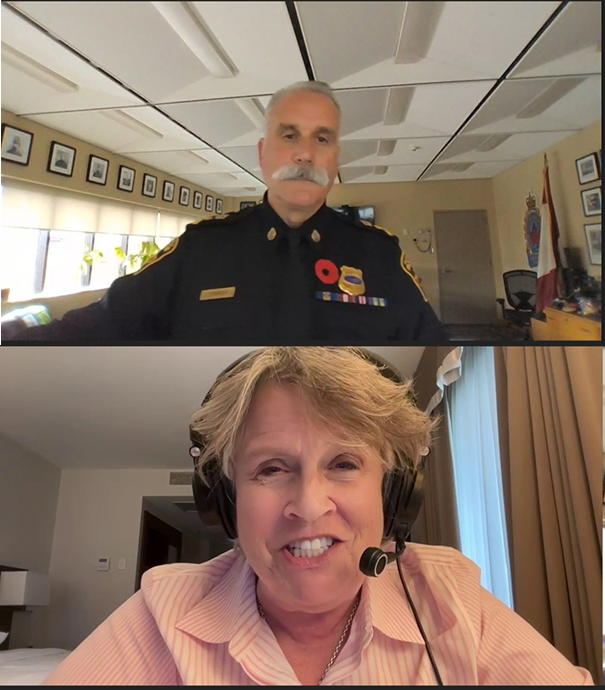
Community leadership isn’t everyone’s responsibility, though CityTalk host Mary Rowe certainly believes more residents can, and should, do their part. That approach is also becoming the credo for progressive police work in Canada’s urban centres.
Mary welcomes Frank Bergen, Chief Constable of the Hamilton Police Service, to explore how it works in his city…and can work everywhere.
Full Podcast
Transcript
Note to readers: This video session was transcribed using auto-transcribing software. Questions or concerns with the transcription can be directed to [email protected] with “transcription” in the subject line.
Mary Rowe: This is City Talk the podcast presented by the Canadian Urban Institute, or CUI, and I’m Mary Rowe. At CUI State of Canada City Summit in Ottawa, which you’ll be hearing a lot more about here in the coming weeks, much of the conversation about what’s working, what’s not, and what’s next explored ways to improve things on a national scale, which is a necessity given our rapidly shifting economic reality. However, as you know, much of CUI’s ongoing work is presently focused on the hearts and spines of our communities, our main streets and downtowns, equipping city builders, sellers, and dwellers to plan, invest, and shape these critical pieces of infrastructure at street level with smart data and innovative solutions to make Canada stronger from the ground up. CUI’s downtown data and strategy work continues to highlight the importance of cross-sectoral partnerships. It’s kind of no one and therefore everyone’s problem are downtowns. Just remember, like an apple, cities will rot from the core. So we have to pay close attention to what’s working, where, and why, as we see probably over a hundred downtowns struggling in Canada in large and small urban communities. Arguably, the longest arm of municipal government needs to be engaged creatively in developing and implementing effective strategies. And that’s the local police force. Not always an easy relationship to navigate across governments, with communities, with businesses, with advocates. But we’re clearly in this together. I was recently introduced to a gentleman in blue who’s put a priority on implementing a place-based people-first strategy. A career constable for many years in Toronto and has just announced his retirement next year. Frank Bergen is the chief constable of the Hamilton Police Force. Chief, welcome to City Talk.
Frank Bergen: Thank you very much, Mary, and what an honour to be here. A week and a half ago, we shared the stage for a bunch of, I don’t know, 300. I guess 300 collected for our morning session in Hamilton to talk about not only transit uh challenges, but also uh understanding the impacts of what is a revitalization look like and a 10-year revitalization plan. Mary, I I’m I’m a police officer, but I I’m also, as I said, I’m the Joe Biden of policing in that I’m in my 45th year. 36 years.
Mary Rowe: Does that make you the Joe Biden of policing? Good heavens.
Frank Bergen: I uh I don’t know what else I could be, but um what what I have and what I’ve been able to do here in the city of Hamilton is understand that after 36 years working in the downtown Toronto uh environment, but coming here, living in the city of Hamilton, uh we have challenges. We absolutely have challenges. So hopefully over the next little while, you and I can um talk about some approaches and what we’re doing here in the city of Hamilton. Uh we’re not done yet. We have a lot of work to do because what we are understanding is they’re they’re happening all across Canada. And as you said in your talk, uh well over a hundred uh cities are actually actually um struggling uh, you know, with a way forward on this. Maybe, maybe during this conversation we can uh come to terms with some of those key things that may make a difference for someone who’s listening.
Mary Rowe: Absolutely. Well, we often say that there’s lots in common that we share in communities of all sizes across the country, but each particular challenge is specific to a place, as we know. There are examples of initiatives that smaller communities are taking in some cases that larger communities could mimic. And similarly, sometimes larger places have success with certain kinds of approaches that other communities should be trying as well.
Frank Bergen: Yeah, you just got to try. There are so many opportunities. As I said when we met, I really uh sort of have a foundation in the way I operate and work with the Hamilton police. But more importantly, the community is I have four key areas that are important to me. Um, number one is be where we need to be. And in that, we can unpack later. But I mean, I have legislative authorities. I have more importantly, what is the actual core function of policing, but also you must be able to address the complex issues of a large city. In our case, it’s like everyone else, but we are dealing with a very much focus on homelessness, addictions, and mental illness. That represents about 41% of our calls for service. And with that, you’re not going to do it alone. I’m a strong believer in collaborations and partnerships. And it’s that collaboration and partnerships which brought us to that breakfast that brought us to us having you as a sage keynote speaker, being able to talk about your experiences, but more importantly, about what are the positives? What can we deal with?
Mary Rowe: Sage, that’s kind of code for old. I should do the math and see whether or not I’m the Joe Biden of urbanism. But but um, or uh, you know, we could be the Jean Chrétien at these things, which would make us that much older.
Frank Bergen: That might be better, yeah.
Mary Rowe: Yeah. But just you you start to say there are four things. The first was be where you need to be. What’s the second one?
Frank Bergen: Um, it’s dealing with the complex needs of a large city. Okay. Um, and and in that, in that, if you’re looking at the actual core functions of policing, it’s crime prevention, law enforcement, assisting victims, public order, and emergent response. In policing, emergent response, cool. That’s how we get to drive fast. We get to be able to respond and deal with managing some 911 issues, emergencies. Crime prevention is is really troublesome in the sense of what is the crime you’re preventing. And in many cases, you’re looking at what each community is, seven crime indicators, all of these things. These are language that speaks within the North American, I guess, um uh lexicon of policing. And in our case, um, our actual shootings from 2024 down to 2025 um were reduced by 50 percent. Um our actual shooting.
Mary Rowe: So that would that would qualify as crime prevention.
Frank Bergen: It will it does, but but again, in crime prevention, when you’re looking at policing having no borders, so therefore we border upon uh the Niagara Um Regional Police Service, Brantford, we have Halton, uh, and obviously the Ontario Provincial Police. So actually, crime prevention can also be displacement of crime, and they could just move along depending on the attention. You can just shove it over.
Mary Rowe: Yeah, not so great.
Frank Bergen: So actually, our our seven crime indicators has been trending downward. So when we look at a community that is concerned about a downtown core, their perception of safety does not always reflect what your statistical data tells you about what crime is. In our jurisdiction, youth crime, youth crime is a problem. It’s absolutely a problem. And in those, when you’re looking back and reflecting, much like many communities, we have actually had a disconnect in our school boards. We no longer have an active, vibrant school resource officer program. So trying to have that relationship and deal with it. But what we’ve seen on the street, 11-year-old, 12-year-olds, 13-year-olds already entering a criminal path. And those things are very, very troubling. On top of that, that social disorder and us challenging, again, coming out of COVID, um, homelessness. And at the peak of homelessness, um, the amount of tents and such that overtook our parks, overtook the laneways, et cetera, in order to try and find the right thing, a balance of doing what is right and looking after the dignity of everyone deserves a human right to live within a city, but also to make sure that you had the ability to follow and to articulate the understanding of a bylaw and authority within a community. What is a community and what is community safety? What is public safety? We also have some limitations with maybe an interpretation of a federal government under Bill C5 that is no longer prosecuting simple possession of a narcotic. And so here in our city, we’re trending right now over the national average over 40% higher in our overdo overdoses and overdose death to our fentanyls and our opioids that are on our streets. That is actually extreme.
Mary Rowe: Why are you so much higher than everybody else?
Frank Bergen: And again, I’m going to be to be cautious, but there are cycles of government and there are approaches that actually believe it’s everyone’s right to do whatever they want. And with that, and with approaches on injection sites, et cetera, um, and and safe supply, et cetera, uh, it does create a problem and it’s compounded by opening your city to to homelessness and maybe allowing people to do what they want. And therefore you have a point of no return. When the provincial government um started to change its approach to mental illness, mental health. Um, I again, being a Toronto copper, it was commonplace on an apprehension to take someone to 1001 Queen Street, CAMH. And right now, those those facilities and that um ability to transfer that apprehension is is non-existent. And right now our hospitals are just overtaxed with with challenges and being able to prioritize what is occurring in an emergency room. And as such, people are out on the street. And and and so when you’re looking at those pressures, they fall on a default service provider, police, emergency services, paramedics, fire. And if if you don’t, as a community, understand the overarching challenges of risk intervention and prevention. Mary, you you said you were talking about that $1 invested, how it spawns a $6 return on economic. I look back in in the old term of defining this, it really was that same dollar really changed out to $7 return on being able to divert recidivism and that other thing. So that ounce of prevention is a pound of cure, is something that we look at. And that’s the complex needs of a large city. Can’t do it alone. And that’s to my third and fourth. It is about collaboration, it is about partnerships, making sure that you have that ability. There’s only one dollar available for things in a city, and we all have our hand stretching that loonie.
Mary Rowe: So let’s just do the summary. Number one, be where you need to be. Two, appreciate the complex needs. Three, collaboration.
Frank Bergen: Yes. Four, as it’s just a partnership. So there’s two different layers of collaboration. Now, on top of everything, on top of everything, in 2020, we went through what is a national spotlight on the legitimacy of policing and the death of George Floyd. Yeah. And everybody understood and understood that that precarious moment of public trust and the legitimacy of policing, yeah, that coupled with all of these other complex things, who would, in their right mind, from a social service delivery program, want to work with police. Policing is messy. We have the authority to take somebody’s rights away. And in this particular case, in our community, the loudest voice was defunding police. Yes, the detasking police. When then you’re dealing with those complex needs, at the end of the day, the default service provider, 24-7, are emergency services.
Mary Rowe: But also, sometimes a librarian. I mean, people, all sorts of people are being put into these circumstances where they may or may not have the training and they almost almost certainly don’t have the resources to be able to fully respond to what the situation is, which is why I think you’re suggesting we need more than just collaboration. It can’t just be, hey, can you help me out? It’s also got to be we’re gonna collectively together form a kind of collaborative but partnered arrangement so that it’s very clear this is my role, this is your role. And here’s how together we’re gonna put the needs of that person in the community first.
Frank Bergen: That’s exactly it. It’s framing the conversation that that if we’re looking at bill C five and we no longer have the ability to deal with uh simple possession.
Mary Rowe: And simple possession is So what is Bill Custom, but Bill C five did what?
Frank Bergen: Bill C five altered the actual approach to simple possession and simple possession, a police officer’s now authority is a do nothing, B interrupt with an arrest and handcuffs, and then try to articulate why and when and what got that simple possession into an authority of taking somebody’s rights away. But more importantly, what it is and where we generally have to find is somebody who then can assist in addiction counseling. So I’ll use I’ll use what we do here in the city of Hamilton. It it is the the rapid access to addiction management. So it’s the RAAM Clinic, which is a division of St. Joe’s Hospital. Right. So so out of out of the the first year that the Bill C5 affected us was in 2024. We had only 124 interactions for simple possession. Quite frankly, the Hamilton Police Service didn’t know what to do with that. Didn’t know what to do with it. I’m gonna arrest you, I’m gonna hold you, I’m gonna take your rights away, but I already know there is no consequence. They’re not going to proceed. So then in 2025, 950 interactions for simple possession, of which 160 so, I’m not gonna be perfectly accurate on this, then were referrals to the RAAM clinic. This year we’re well um tracking well over 1,300 interactions with over 200 referrals to the RAAM clinic. Once we have been able to establish someone is not availing themselves of treatment and we have to verify and track that, then we have the default where then we have to articulate upon arrest to a uh prosecutor the attempts we made. Uh you know, I I met with Frank Bergen on the street seven times and through these interactions. On the eighth time Frank availed himself to a an intake at the RAAM clinic, uh two unsuccessful attempts at at that addiction counseling turned into now my 10th or 11th interaction with Frank Bergen. I’m bringing him before the courts. And if I can articulate that, then we can have some court control on the outcome of that particular interaction.
Mary Rowe: You know, this is just sort of soul destroying, isn’t it? Because these are people who have, for a whole bunch of different circumstances, ended up in a situation. And I often say, you know, Frank, that if you’re a city builder, if you’re in the urban business, you’re you’re all about empathy. Cities are about empathy because I coexist next to someone who is not like me, who has a different story than I have. That’s how urban life is is underpinned by, it’s underpinned by that value. But the dilemma is that one person’s tragedy can also affect the business that they’re standing in front of, or the uh the or the transit system that someone then feels uncomfortable taking because they don’t know how to navigate someone who’s having a mental health crisis. And your colleagues are in the midst of that. It’s a tough spot that we’ve put cops in, eh?
Frank Bergen: Well, it’s not just cops. I think it’s the tough spot you put a community in because you’re absolutely right. And and the cost of compassion and and and and compassion is an amazing thing until it disrupts the actual safety of a community. And that’s when we hear it from our our BIAs. But crime prevention through social development and understanding that in fact we have to step back to lead in many of these files. So one of the things I think was a success in the city of Hamilton was when we introduced in 2021, and it actually started to be formalized in 2022. But I’ll be a spoiler alert. Right now, in 2026, going into 2027, we’ve had difficulty sustaining the program.
Mary Rowe: And that’s what’s the program?
Frank Bergen: The rapid intervention support team. So out of an envelope from the province of community safety, yeah, um, I was given 9.8 million dollars. So it’s the rapid intervention support team. Support team is crime prevention through social development. If you do not fund and do not bring partners to the table, which is in many cases, people call it a syndicate, they call it a focus table. There’s many names all across 100 cities of this beautiful country. But in our risk model, it was taking $1.4 million of the 9.8. And I underwrote the actual cost of bringing in a housing worker, an addiction counselor, of someone from Hamilton Regional Indian Center. Uh so we could sit in there. And at one point, at the height of it, at the height of it, we had um 11 community partners sit at that table. And over a three-year grant cycle, we were able to underwrite some of those costs. Those costs that would make sure at the beginning on Monday morning, I’ll use an example. Monday morning, you have 50 files in front of you, 50 people, 50 clients in front of you on pieces of paper. Yeah. If you start pulling out the files and looking in these different envelopes, um, Frank Bergen today needs to get a health card. Frank Bergen needs to get to court. Um, Frank Bergen needs to have transitional housing. Yeah. In those files, I haven’t heard that a cop needs to be there. And so you start doing that. And if you actually invest in that model, what we found in normal interactions without any support, without collaboration or partnership, police are responsible for 100% of the work. Mobile crisis rapid response, when you are bringing a cop and a triage nurse together in a vehicle patrol, you’re down to 75 to 70% response of a police thing, whereas the other 25 or more is given to that team. With the rapid intervention support approach of those 50 files, 15 to 18% are police responsibility. And and you start now then thinking about what we’re able to do, what we’re able to do in the menu of police area, in our area of responsibility. That’s an amazing opportunity to change, to say, put the person who is responsible for a better outcome at the front of the model. That’s risk intervention, that’s prevention. It’s not just relying at two o’clock in the morning just being a cop.
Mary Rowe: Yeah.
Mary Rowe: I don’t want I don’t want to trivialize this because I think this model is so fabulously important, what you’re suggesting. It’s because I was going to trivialize it by saying, you know, you don’t ask the person at the front of the restaurant to go out to the back and start making the food. So that’s the disruption that you were making with the risk program. Although you guys initiated it, the cops initiated it and you were funded. But in many ways, what you were doing was recruiting partnerships for the other folks to step up, because it might be in, you know, three-quarters of these cases, they should be the lead, not you.
Frank Bergen: That’s right. And it’s it’s again, it’s the step back to lead. In in this area and this responsibility, these are the things that are that are very appropriate. But but again, sustaining a model, sustaining the funding. So the provincial shift right now is grants are no longer on a three-year grant cycle. They’re on a one-year grant cycle. On a one-year grant cycle, it’s very, very difficult to get a small social service delivery guaranteed. They can’t, they don’t hire on those cycles. We don’t function that way. We we’re trying to do that. I mean, we need to.
Mary Rowe: I mean, if we were serious about this, we would find a sustainable, predictable funding source. We would find uh we would have some permanence to these kinds of uh, I want to call them triage desks. Uh the other thing that I’m interested in is that it’s 80 people. I mean, I know we know this from talking to people who have addressed homelessness successfully. It’s a named list. You know that it’s Frank and it’s Mary. And Frank and Mary are repeatedly coming into the emergency room. They have chronic needs, and we need to case manage Frank or Mary into the support they need. But that takes steady investment, lots of partnerships. Gee, somebody, you know, now it’s time for social services to come to the fore. Now it’s time for the housing provider. It it’s a it’s a care infrastructure we’re creating here.
Frank Bergen: I I absolutely agree. And when I speak with um our ministry partners here in our city, but more importantly, doing amazing work. And I’m going to be very, very complimentary. But in many cases, I’m not always confident that the the Ministry of Education, the Ministry of Health, the Solicitor General Office, the courts, I’m not always 100% confident they are approaching this model in the same way. And they’re looking at siloed grants, funding, et cetera. But but if we can on a on a very, I guess, um simple example how I see it and how we see it here in the city of Hamilton, is our relationship with St. Joe’s is is just absolutely critical in order to understand, because they too, just like you said, those same amount of people, Franks and Mary’s, are filling up their emergency room. There are there is a segment of our community that no matter what you do, it’s going to be very, very precarious to get them out of this cycle. That isn’t an absolute reality. It’s it’s sad, but but it but again, it’s not hopeless. Meaning there are social service platforms, programs, people who have those abilities and have those connections. And I’m confident at some point during these journeys, someone will avail themselves of a lifeline. And I do believe in many cases that lifeline then can be that opportunity.
Mary Rowe: Yeah.
Frank Bergen: When when when I did it, when I did a downtown um um crime summit in May, we actually Believed that we would come out of that and it would be very clear that the number one concern was youth crime. We actually had a series of challenges. We had a 14-year-old killing a 16-year-old coming into our downtown mall, Jackson Square. We had a 19-year-old gun down on a Friday afternoon. We had a young girl killed up on the top of Brow on our shelf here up in Upper James. We had these time after time after time examples of youth crime gone awry. And so we go to the meeting, we have 80, 81, 85 people at this meeting. We have a conversation. And as we now get to the afternoon and we start defining what would be success, what would uh at this day in this conversation, what does success look like? It was social disorder. It was social disorder. And this, the same people who are both investor and community leaders, uh social service providers, they all agreed it was not only just the perception of safety, but it was truly dealing with, again, social disorder. And once we recognized that, then we quickly turned around and said, okay, we’re returning to a downtown substation in the Jackson Square. If anything, it’s it’s the optics for those employees who do not want to come to the core. And when you’re looking at a downtown core, the numbers are staggering. The numbers are staggering. We have we have we have over 700 provincial employees in the core. We have we have companies, insurance companies that have over 200 employees. We have banking institutes that have hundreds of employees. And those people who are rather work from home as opposed to look at the vibrancy of being in the moment, they’re making choices. They’re taking their afterwork dollar to a restaurant elsewhere. They’re not bringing the kids to shop in the downtown stores. Right, right. They’re going elsewhere. And how do you change that conversation? You tackle social disorder together. And we use our motto. We shared our motto, and it’s been our brand, Together Stronger, Safer. Obviously, that leans towards a policing connotation, but Together Stronger Safer is really a larger complex understanding is that we can do this. We can work together, we can find what is public safety, community safety, and we can put it in a bow, and we just got to keep showing up every day to change that narrative.
Mary Rowe: I actually like uh Together Stronger Safer. I think that could be everybody’s motto. You know, you know the old adage, Chief, that you know, the the safest street is the one that is busy, full of people. So whenever, you know, when I travel and people say, Oh, do you feel safe there? You know, I feel safest on a busy street at any time of the day or night than I would an empty street. So people are critical to our sense of safety. And so together to me is absolutely communicating that. So just as we round out this, you’ve had the RIST, the RIST program. If you had a magic wand, what and you had unlimited resources, those are two really important preconditions. What would you be doing that you’re not doing now?
Frank Bergen: Yeah. I actually love that conversation because I’ll tell you in the city of Hamilton, and I’m now in my budget cycle, it’s never been easy. It’s never been easy to understand the cost of policing, and it continues to rise. Um, cost of policing is actually really it’s 92% of my budget are people, are people. I have very, very little flexibility on that. But but I think what we need to do sometimes is put aside the rhetoric, put aside the agendas, and have a conversation. Define what does community mean. Yeah, have a conversation about understanding it, making sure that there is uh a return to courtesy, a return to understanding of what it is to be in a larger network. As you said, uh, the the network is defined by its vibrancy, vibrancy is defined by activity. And in this particular case, there’s nothing else. I’m I’m not coming to the table to like my counterparts and asking for a helicopter or asking for all these extra things because it boils down to is we need to understand what is our core function. In that core function, primarily it is about prevention, but it also is assisting victims of crime. Assisting victims of social disorder are those that are both stuck within that cycle, also means it’s everybody’s responsibility to find out how collaboration and partnership can aid uh uh growth of a city and not a reduction of the actual quality of life. So no, no magic wand. I think what we just need to do is continue to discuss it, continue to have those opportunities to look at. But I think if the end of the day, uh a good breath every morning uh gives us that opportunity to be a good citizen and a good person and contribute to the betterment of the city and stop uh stop looking at your phone, stop worrying about yourself and making sure that you can give something back to the community, and that helps us all.
Mary Rowe: Don’t know if you remember Jane Jacobs’ famous phrase. Absolutely. Uh eyes on the street, not on your phone, eyes on the street. And we all need to be reminded of that, that each of us has uh our own capacity to contribute to the environment in which we we choose to be and what where we hope we are with others. So, Chief, thank you for joining City Talk. Always interesting to hear the experiences of different places, but particularly to hear about the leadership that you’ve been providing, the lessons you’ve been learning. And uh, we won’t lose your phone number. We’re gonna continue to track how you’re doing and how things are going uh in Hamilton. Thank you for joining City Talk.
Frank Bergen: Thank you very much, Mary, and I really appreciate this opportunity. And the best advice I can give you anybody who wants to be a leader, get out of the way. Have a great day, everyone. Thank you.
Mary Rowe: Thanks, Chief. You know, among TV and movie screenwriters, apparently there’s a maxim which goes, no one wants to watch what cops actually do for a living. It may not always be a thrill a minute, but what Chief Bergen and his colleagues are doing for our communities keeps us much more than simply safe, which is why these partnerships are so crucial. A reminder that you can talk back to us with an email at [email protected] or use the Talk to Us From Your City link under the podcast description to send us an instant text or a video message. I’m Mary Rowe. Thanks for listening.