

Summary
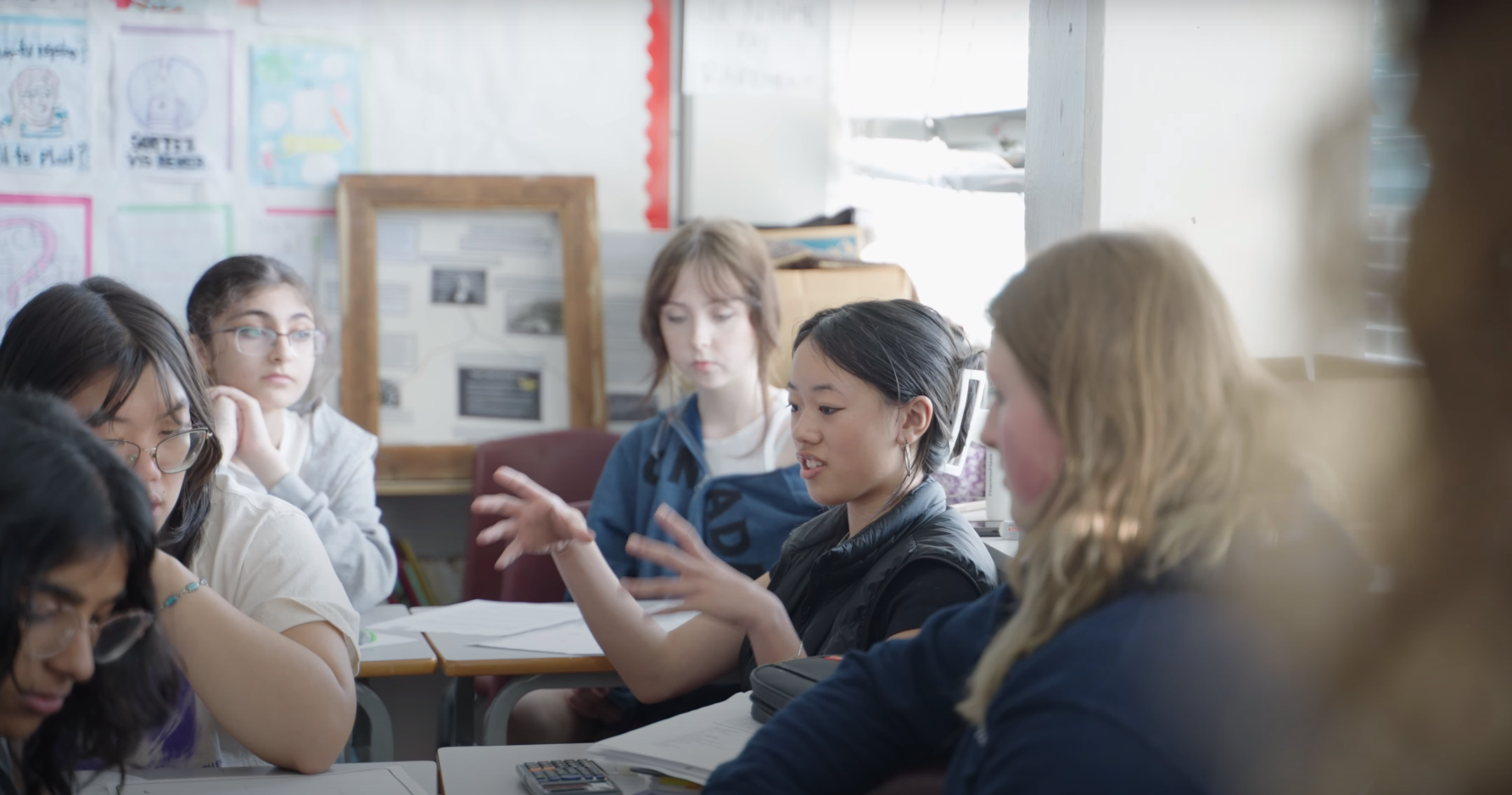
Photo of the CityHive Vancouver CityShapers in Schools program.
Thank you to our partner at the School of Cities at the University of Toronto for co-hosting this event.
There are over 8 million Canadians under the age of 19. These young people are a core part of our communities, sharing in our collective future. Yet there are few opportunities for children and youth to learn the skills they need to practice positive civic engagement. In part, these challenges are structural: youth below the age of 18 are often excluded from formal decision-making, and few public engagement processes have formal channels for youth participation. But many young people are eager to play a more active role in solving problems in their schools and communities, and can bring unique insights to the table.
On this week’s CityTalk, Mary Rowe sits with a panel of changemakers working with young people to shape their communities and include them in civic conversations as we grapple with issues like the future of housing, mobility, economic opportunity, and sustainability. Panellists discuss why it is so critical to include younger voices in decision-making, how to give them the tools and knowledge they need to lead, and what role institutions and municipalities have in engaging these young leaders.
5 Key Takeaways
1. Transit projects are driving displacement without safeguards
The panel stressed that conventional transit-oriented development often accelerates speculation, quickly drives up land values, and leads to the loss of “naturally affordable” units near new lines. As private developers assemble land around future stations, existing tenants—disproportionately low-income, racialized, and equity-deserving residents—are displaced and pushed farther from jobs, services, and transit. Without policies that link transit planning and land-use planning, public investments end up worsening housing affordability and undermining equity goals along transit corridors.
2. CATCH’s Hamilton pilot shows how blended capital can work
Dina Graser outlined how CATCH emerged from a Hamilton lab that brought the city, CMHC, nonprofits, and philanthropy together to respond to a new 14 km LRT running through some of the city’s lowest-income neighbourhoods. The partners co-designed an $18.7 million blended capital fund—combining public, philanthropic, and private dollars—to offer flexible, low-cost acquisition, pre-development, and construction financing to non-profit and community housing providers within 800 metres of the line, coordinated with the city’s grant processes. The aim is a revolving, scalable model that preserves existing stock, enables new non-market units near transit, and can be adapted and replicated in other cities across Canada.
3. Policy and regulatory change are as important as money
CATCH’s work in Hamilton shows that local regulatory tools—such as upzoning, rental protection, and anti-renoviction bylaws—are crucial to making non-market transit-oriented housing feasible and faster to deliver. For example, when Hamilton upzoned to allow fourplexes as-of-right near the LRT, a nonprofit with a portfolio of single-family homes could pivot to densify its sites instead of selling, shifting from incremental change to meaningful scale on the same land base. The panel also highlighted the “gap” at senior government levels, noting that federal transit funding can require affordable housing plans without resourcing municipalities to do them, and national housing programs still do not systematically prioritize proximity to transit.
4. Nonprofit housers need scale, unlocked equity, and fair rules
Lisa Ker and Ray Sullivan emphasized that Canada’s community housing sector—roughly hundreds of thousands of units delivered by about 7,500 providers—must grow significantly, but cannot do so under current constraints. Many nonprofits sit on substantial, “trapped” equity in aging buildings, yet title restrictions, operating agreements that claw back surpluses, and rigid program rules prevent them from leveraging that value or borrowing against reliable cash flows to reinvest and grow. The panel argued for enabling mergers, portfolios, and mixed-income models, so community providers can scale up, use their equity, and compete in real time for land and projects in hot transit-oriented markets, rather than being structurally sidelined by the private sector.
5. Community stewardship and resident voice are central to equitable TOD
Beyond finance and regulation, the speakers underlined that equitable transit-oriented development depends on community stewardship and meaningful participation from those who rely on transit and affordable housing. Ker noted that transit users—often lower-income residents—are frequently least involved in decisions affecting their neighbourhoods, and argued that structured, early, and ongoing engagement can actually speed projects by reducing conflict and “risk,” rather than delaying them. Graser linked this to CATCH’s national vision: building a centre of excellence, convening municipalities and housers, and embedding community input so that future transit investments support long-term affordability, mixed-income communities, and resident stability instead of repeat cycles of displacement.
Full Panel
Transcript
Note to readers: This video session was transcribed using auto-transcribing software. Questions or concerns with the transcription can be directed to [email protected] with “transcription” in the subject line.
Coming.
Full Audience
Chatroom Transcript
Note to reader: Chat comments have been edited for ease of readability. The text has not been edited for spelling or grammar. For questions or concerns, please contact [email protected] with “Chat Comments” in the subject line.
00:48:32 Canadian Urban Institute: 👋 Welcome to today’s CityTalk!
✅ Say hi in the chat & let us know where you’re joining from!
💬 Set chat to “Everyone” so we can all see your comments.
🎥 This session is being recorded and will be posted at citytalkcanada.ca next week.
📝 Captions are available — use the CC button below to toggle on/off.
💡 Share your thoughts, links & questions in the chat!
🙋♀️ We can’t respond to raised hands, but we’ll do our best to answer questions shared in the chat.
📬 Subscribe to the CUI newsletter: https://canurb.org/subscribe/
📱 Follow us on LinkedIn & Instagram @canadianurbaninstitute
🌐 Watch every CityTalk Live & Podcast episode: citytalkcanada.ca
00:48:53 Canadian Urban Institute: The event will begin shortly after 12:00 p.m. ET
00:49:41 Canadian Urban Institute: What you’re listening to:
Lou-Adriane Cassidy, Dis-moi dis-moi dis-moi
Bibi Club, La terre
00:52:23 Canadian Urban Institute: 👋 Welcome to today’s CityTalk!
✅ Say hi in the chat & let us know where you’re joining from!
💬 Set chat to “Everyone” so we can all see your comments.
🎥 This session is being recorded and will be posted at citytalkcanada.ca next week.
📝 Captions are available — use the CC button below to toggle on/off.
💡 Share your thoughts, links & questions in the chat!
🙋♀️ We can’t respond to raised hands, but we’ll do our best to answer questions shared in the chat.
📬 Subscribe to the CUI newsletter: https://canurb.org/subscribe/
📱 Follow us on LinkedIn & Instagram @canadianurbaninstitute
🌐 Watch every CityTalk Live & Podcast episode: citytalkcanada.ca
00:53:06 Warren Waters: Lowertown, Ottawa
00:53:15 Caillie Pritchard: Calgary, Alberta
00:53:26 Yvette Rogers: Hi from Victoria County (Unama’ki / Cape Breton Island, Nova Scotia)
00:53:27 Sophia LeBlanc: Hi there! Grande Prairie, Alberta!
00:53:40 Scott Dillman: Hi from Dartmouth, Nova Scotia!
00:53:57 Falynn Bilyk: Hello! Edmonton, Alberta
00:54:04 Brown, Joy: Greetings everyone, my name is Joy and calling in from Toronto, Canada. As a side note, would love to get a list of the songs being played 🙂
00:54:56 Canadian Urban Institute: Reminding attendees to please change your chat settings to “Everyone” so we can all see your comments.
00:55:20 Mike Des Jardins: Good morning from Hamilton, Ontario!
00:55:28 Miklos Horvath: Very nice – Bibi Club! Excellent choice.
00:55:47 Adriana Appau: St. Albert, Alberta
00:55:58 Cassie Smith: Hello, Cassie joining from Algonquin Anishnaabe land here in Ottawa
00:56:01 Greg Jodouin: Hello from Ottawa
00:56:02 Donya Shafaei Ahmadsaraei: Hi from Halifax, Nova Scotia !
00:56:07 Andrea Steenbakkers: Hi from Ottawa! 🙂
00:56:23 Ricki Schoen: Hello from Ireland 👋
00:56:29 Rola Hamdan: Hello from Toronto
00:56:30 Mary Pickering: Here from sunny Peterborough Ontario
00:56:38 Andrea Betty: Hello from Penetanguishene!
00:56:47 Kimberley Nelson: Hi from sunny Blue Sky Calgary, Alberta
00:56:57 Canadian Urban Institute: Thank you to our event partner at the School of Cities at the University of Toronto:
https://schoolofcities.utoronto.ca/
00:57:13 Kate Twiss: Hello, from the unceded territory in Algonquin Anishabe in Ottawa. Not sunny here, but pretty in a frosted way.
00:57:14 Canadian Urban Institute: Register Now
The State of Canada’s Cities Summit
This December 3-4, 2025 in Ottawa
Join the Canadian Urban Institute and an assembly of city builders to assess the state of our communities and set a course for our cities’ futures.
https://stateofcitiessummit.ca/
00:57:15 John Divinski: Greetings from Saugeen Shores (Port Elgin; Southampton) on the shores of Lake Huron.
00:58:48 Luis Patricio: Good morning, afternoon or evening to everyone. Tuning in from London, Canada, the land of the Anishinaabeg, the Haudenosaunee and the Lunaapeewak.
01:00:02 Canadian Urban Institute: Check out recent CityTalks at: https://citytalkcanada.ca/discussions/
01:00:14 Canadian Urban Institute: There’s the Money! What The Federal Budget Means For City Building https://citytalkcanada.ca/discussions/theres-the-money-what-the-federal-budget-means-for-city-building/
01:01:30 Emily Paterson: Here from Vancouver today 👋
01:02:14 Canadian Urban Institute: Lanrick Bennett Jr.
Urbanist-In-Resdience, UofT’s School of Cities
Toronto, ON
Lanrick Bennett Jr. is Toronto’s first Bicycle Mayor and currently serves as Manager of Donor Education & Engagement at United Way Greater Toronto. In that role, he designs immersive experiences and educational opportunities that help donors understand the interconnected challenges facing communities across the GTA. Lanrick also holds the position of Urbanist-in-Residence at the University of Toronto’s School of Cities, where he advocates for equitable mobility and sustainable city-building. His work focuses on climate justice, public space, and building cities that prioritize people over cars.
01:03:39 Elaine Smith: Elaine Smith, Hillcrest Village BIA, Toronto..a CUI fan…not just a lurker!
01:04:10 Lara Muldoon: Applications now open for Urbanist in Residence at the School of Cities -as well as Early Career Canadian Urban Leader (for all the young vibrant CityTalkers!) https://schoolofcities.utoronto.ca/programs-opportunities/visiting-experts/
01:07:15 Alex Callaghan: walked
01:07:15 Mary Pickering: Walking
01:07:16 Allison Pilon: Walking! or Bus
01:07:18 Andrea Betty: bus
01:07:18 Kimberley Nelson: Walk, bus, bike
01:07:18 Karyn Kipper-Day: Walking or public transit.
01:07:19 Amanda Mosca: walking
01:07:19 Yvette Rogers: walk, schoolbus
01:07:19 Teresa L: bus
01:07:20 Michelle Zhang: TTC streetcar and subway!
01:07:21 Ridley Soudack: Transit
01:07:22 Katherine Danks: Streetcar and subway
01:07:23 Sophia LeBlanc: County bus system!
01:07:23 Shiloh Bouvette: Walked.
01:07:24 Zainab Abbasi: bus or walking
01:07:25 Taylor MacIntosh: Walked – straight up Halifax hills!
01:07:25 Mackenzie Betteridge: Bus or car
01:07:25 Caillie Pritchard: car with parent
01:07:26 Emily Paterson: drove I could have walked to high school 25 min walk but didint
01:07:28 Scott Dillman: I was homeschooled so I walked upstairs
01:07:28 Cheryl Cohen: walk or bike
01:07:29 Ricki Schoen: Cycling
01:07:29 Lara Muldoon: walk
01:07:29 Laura Pfeifer: Walked, bus… occassionally got a ride in highschool
01:07:29 Tracy Tang: TTC!
01:07:29 Wendy Rinella: walk
01:07:30 Nicole D’souza: Walking or bus
01:07:30 Allister Andrews: TTC
01:07:30 Christy Bertrand: walked miles up hill both ways
01:07:32 Marilyn Cameron: Walking, car, public bus (high school)
01:07:32 kirsten mccauley: walking elementary, bus high school
01:07:35 Brown, Joy: Walking or Bus (mix of both)
01:07:35 Melodi Lepage: Walk/bum rides/bus
01:07:40 Alex Tabascio (CUI): Car (When I had band practice) But usually bus and subway
01:07:42 Brenna MacKinnon: school bus
01:07:44 Donya Shafaei Ahmadsaraei: walk
01:07:44 Rochelle Brien: I walked to grade school (1 block), middle school (6 blocks), and high school (3 blocks)
01:07:45 Kim Selman: Walked for elementary. Bus (public transit) to high school or a very long walk!
01:07:46 Simon Massey: Walk and ride bike
01:07:47 Warren Waters: walked
01:07:54 Erica P: Walked 5-10 minutes to school
01:07:54 Andrea Spakowski: Walking, school bus.
01:08:00 Elaine Smith: From Age 6 Walked far with my little brother
01:08:01 Canadian Urban Institute: Monica Cheema
Coordinator, CityShapers in Schools, CityHive
Vancouver, BC
Monica Cheema (she/her) is a filmmaker, facilitator, and researcher based between Fleetwood-Surrey and East Vancouver. She works at the intersection of art, education, urbanism, and community organizing, weaving these disciplines together to foster critical thinking and engagement. Her work in classrooms encourages young people to reflect on their connection to land and each other. She values students as knowledge holders and tailors place-based programs to meet diverse learning needs, fostering accessible and engaging experiences for all. Currently, she consults on various public space planning initiatives in South Vancouver. Monica sees storytelling as a transformative tool for fostering dialogue. She has had the privilege of sharing her media-based work at The Polygon Gallery, Surrey Art Gallery, James Black Gallery, Mayworks Festival, Vines Festival, DOXA Documentary Film Festival, and Gallery Gachet.
01:08:10 Rita Bilerman: Walked!
01:08:26 Minaz Asani: In Nairobi, Kenya, I walked 45 minutes to the bus stop and then took a matatu (the local transportation) for half an hour.
01:08:37 Nicole Huang: school bus for elementary and highschool drove by parent
01:09:08 Yvan MacKinnon: usually running (regrettably because I was perpetually late)
01:09:09 Minaz Asani: My son took the bus till Covid and then I started dropping him.
01:09:19 Kimberley Nelson: I work for Youth en Route that focuses on young adults for transportation literacy. We generally only work with students from grade 10-12
01:10:08 Luis Patricio: In Brazil, I was driven by my parents. The school was 12 kms from my house and it would take me over an hour to bus there. I started taking public transit to most destinations (other than school) when I was 11y.o.
01:13:18 Chris Chopik: my 20 year old has expressed that this reflects his eco-perspective – beyond anxiety https://youtu.be/ZTFFOr_G6ZM?si=ygFJTgFXww8qjIg1
01:13:45 Canadian Urban Institute: Mike Des Jardins
Senior Community Animator, Tamarack Institute
Hamilton, Ontario
Mike is a certified teacher in the Province of Ontario who has worked directly with youth through program and service delivery and indirectly supporting youth by creating the system conditions to support their learning, development and well-being. He is passionate about valuing youth as leaders of today based on their unique skills and assets. With the Tamarack Institute, he is supporting young people and adult allies through youth centred collective impact work in small, rural, remote, Indigenous communities across Canada.
01:14:23 Allister Andrews: Yup!
01:15:25 Chris Chopik: I started taking the subway on my own in Toronto at 11, and was free to roam by bike or walking to school, after school…
01:16:21 Elaine Smith: Note: When things happened on the walk to school in the 60s there was not a big deal made of it…children were not scared to keep going out into the world..heli-parenting didn’t help young people develope these skills..
01:16:24 Jenny Trinh: Could Mike repeat the name of the model they are using for their project please?
01:16:53 Mary Pickering: Collective Impact Model
01:17:11 Michelle Zhang: https://www.tamarackcommunity.ca/collective-impact-toolkit
01:17:42 Jenny Trinh: Thank you Mary and Michelle!
01:17:53 Laura Pfeifer: Shift if school patterns I think are driven by multiple things – busy schedules (after school activities that are not close to school), school location not always central and walkable, fear from parents, etc.
01:18:10 Laura Pfeifer: Being able to walk to school was a big driver of our decision on home location when we moved cities
01:19:56 Rochelle Brien: While many students in Milwaukee public schools are served by school buses, my children’s school (a K-8 public, Montessori charter school) does not offer bussing. I am not certain of the number of families that live close enough to walk or bike but can say that most families drive (or carpool). The school sees this as beneficial – that having parents, guardians, and other family members on-site helps to build community.
01:20:25 Dallas Gislason: That is definitely true on Vancouver Island. Indigenous populations are much younger than our otherwise aging demographic across the island
01:20:26 Lanrick Bennett Jr.: Equitable movement in our city needs to think outside of car dependency. Youth aren’t driving. How are we giving them safe spaces to move around?
01:20:45 Lanrick Bennett Jr.: A bit on Bike Buses https://greencommunitiescanada.org/ontario-bike-buses-are-revamping-students-routes-to-school/
01:20:53 Kimberley Nelson: 11% of teenagers in an urban center can’t ride a bike / never learned and have not been given an opportunity to learn
01:20:53 Canadian Urban Institute: Eric Lombardi
Founder, More Neighbours Toronto
Toronto, ON
Eric Lombardi stands at the forefront of urban development and advocacy as the Founder More Neighbours Toronto and recently, as Chair of of Build Toronto. Professionally, he specializes in strategy management consulting in the finance and technology sectors.
01:21:44 Laura Pfeifer: Yes to equitable movement! We recently passed free transit for under 13 here in Regina and are considering expanding to high school as well… these patterns and comfort with other mobility options start early
01:22:14 Sarah Armouch: yes youth (15-24) in indigenous communities form a bigger demographic group in comparison to non-indigenous. Mostly in Nunavut.
01:22:18 Mike Des Jardins: Collective Impact is the model we used for collaboration
01:24:24 Luis Patricio: We have free transit for under 13 for a while now here in London ON. There was a pilot project for high school age people but it didn’t move forward unfortunately.
01:25:01 Marlee Robinson: my “child” grew up in Central London England. We lived within 2 blocks of 3 underground lines and 5 bus stops so she never learned to drive – a handicap now that she lives in rural Ontario aged 55.
01:25:08 vicki scully: this is happening during school hours
01:25:29 Mike Des Jardins: Yes!
01:25:29 Melodi Lepage: That’s a great idea!
01:25:36 Laura Pfeifer: Would love that
01:25:38 vicki scully: yes! at all grade levels
01:25:43 Elaine Smith: Volunteering is huge…
01:26:12 Yvette Rogers: There are “Community-based learning” classes and social studies that might be a good fit for aligning with city talk discussions
01:26:25 Lanrick Bennett Jr.: Young People Push for your voice to be heard! ‘A New Agenda for Local Democracy: Building Just, Inclusive,
and Participatory Cities’ via Brittany Andrew-Amofah, Alexandra Flynn, & Patricia Wood https://utoronto.scholaris.ca/server/api/core/bitstreams/fb97eda1-2377-41e6-8ea7-c39b7a6cdda7/content from 2022 but still relevant
01:26:30 Laura Pfeifer: Mobility is also opportunity challenge. When we design and plan in a way that requires or assumes the purchase of a private vehicle it has major impact on opportunity
01:27:19 Elaine Smith: Students in Ontario need 40 Volunteer Hours to graduate…they could be offered more choices to learn about what they are interested in at school
01:28:17 Sophia LeBlanc: Very well said!!
01:28:36 Luis Patricio: The 2025 resident satisfaction survey here in London shows that things look more dire to younger folks:
‘Residents aged 55+ (19%) have the highest perceptions of a very good quality of life, consistent with 2024 results (aged 55+; 22%). This group is significantly more positive than younger residents aged 18 to 34, where only 6% describe their quality of life as “very good.”’ The survey doesn’t include people under 18
01:29:58 vicki scully: city cuts in van will result in the planning, sustainability dept gutted. if youth, voters knew the +/- of funding climate mitigation and sust they would vote for it
01:29:59 Alison Pearson: Love this @laurapfeifer! We, in Region of Waterloo in Ontario have a pilot underway of free transit ridership for youth in high-school in magnet programs. We are hopeful this is the first step of a broader effort.
01:30:38 Dallas Gislason: Hello from Victoria: lowest birthrate in Canada (and, surprise, extraordinarily high housing costs!)
01:30:45 Mike Des Jardins: These are the areas we heard that youth value and want to mobilize around: employment and mentorship, accessible education, identity and social connections, service navigation and access to supports, youth engagement and leadership, and holistic health and wellbeing. And I’d say affordability impacts on each of those.
01:31:35 Canadian Urban Institute: Sarah Armouch
Senior Director of Research & Innovation, Youthful Cities
Montreal, Quebec
Sarah Armouch is the Senior Director of Research & Innovation at Youthful Cities, where she champions bold, youth-driven solutions in skills development, workforce pathways, housing, civic engagement and social innovation. Guided by a belief that young people are architects of the future, not just participants in it, she leads initiatives that center their experiences, insights and leadership. Sarah completed her PhD in Digital Civics at Newcastle University (UK), where she explored how to design meaningful change with youth civic groups. She has consulted with organizations in Canada and internationally, including Digital Moment and the IFRC, and contributed to youth-focused projects funded by IDRC and UNICEF MENARO. A 2021 100 TechWomen awardee, and she helped shape Limitless, the IFRC youth innovation initiative recognized at the Global Good Awards for its impact during the COVID-19 crisis.
01:32:36 Lanrick Bennett Jr.: Touching on spaces for children and youth. Where are the third spaces for young people? Wrote this in Spacing Magazine https://spacing.ca/toronto/2025/06/12/op-ed-their-third-space/
01:34:38 Alison Pearson: In our Waterloo Region Youth Impact Survey (for 9-18 year olds) it is quite notable that only about 1 in 2 young people feel like a valued member of the community. This has huge implications for their current day experiences in the community, as well as where as their attachment to the community as they think about employment, schooling and future of where they will settle. BUT, having the data is the first piece to moving towards change with youth. https://childrenandyouthplanningtable.ca/youth-impact-survey/
01:35:03 Mike Des Jardins: Barrier removal to allow for equitable access to participation and compensation for the time, energy, contributions of young people
01:35:33 vicki scully: very well said!
01:36:01 Chris Chopik: @mary your comment about value preservation is an interesting one… highest and best use predicates optimization of rent – and market valuation. For infill in neighbourhoods this appears to favour two problematic trajectories – highest and best use in neighbourhoods is bigger single family infill, and developer/rental investment leans toward small single units for profit optimization.
01:37:12 Lanrick Bennett Jr.: So much in what is Sarah Armouch is speaking to is frustrating as a parent of two people under 20 that are making noise, but adults aren’t listening, don’t want to listen. Painful to see this up close
01:38:53 Lanrick Bennett Jr.: When’s the last time City Council gave the stage to Toronto Youth Cabinet? https://www.thetyc.ca/ CRICKETS!
01:39:48 Mike Des Jardins: Institutions need to engage differently so that it is authentic
01:39:55 Dallas Gislason: We launched this movement a few weeks ago (www.choosepossibility.ca) and someone this week told me that he can’t sign it because it’s exclusionary (because it mentions “youth” specifically). Pathetic.
01:43:18 vicki scully: all the more reason to embed in schools
01:44:33 Yvette Rogers: Urban privilege really shows vs rural reality in these discussions
01:45:15 Mike Des Jardins: Performative
01:45:32 Luis Patricio: The local health unit now says that 1 out of 3 youth are food insecure. If they don’t even have enough to eat, how can we ask them to do “just a bit more” ?
01:45:32 Alison Pearson: Yes @Lanrick!
01:46:07 Erica Ali: <3
01:48:02 Alison Pearson: Yes @Monica! AND, accountability back to young people about what happened as a result of their involvement.
01:48:03 Lanrick Bennett Jr.: Don’t just ‘consult’ youth — give them decision-making power
01:48:06 vicki scully: green party is advocating for 16 being the voting age. this is one way to give youth influence and make politics listen
01:48:29 Mike Des Jardins: Yes, leadership in the design along the way.
01:48:38 Lanrick Bennett Jr.: Youth Already Do Civic Engagement — We just don’t call it that
01:48:39 Linda Williams: In inner city neighborhoods engaging youth in walking school buses, community odd jobs and programs in community centres and discuss the value of being involved in your community
01:48:40 Lara Muldoon: co-design co-design co-design! Don’t just guess what they might want, ask them!
01:48:41 Eric Lombardi: Also, give high schools are typically voting locations, lowering it to 16 is a great way to build habits around voting.
01:50:10 Alison Pearson: Yes @Mary! Youth-led. Important to work to build the capacity of adults to power-share. https://childrenandyouthplanningtable.ca/data-in-action-report/
01:50:14 Allison Pilon: Yes please!
01:50:16 Kathryn Exon Smith: We need a rethink of civic spaces and spaces for connection generally!
01:50:20 Dallas Gislason: Here’s one: https://ymca.ca/en/news-stories/press-release/six-in-ten-canadians-surveyed-have-little-or-no-sense-of-community-new-ymca-research-reveals
01:50:31 Lanrick Bennett Jr.: co-design co-design co-design! YES YES YES Laura!
01:50:39 Chris Chopik: https://urbanminds.co/about/
01:50:47 Kathryn Exon Smith: Our team at the School of Cities is excited to share more about some of these initiatives in our upcoming collection of Local Solutions that are working across the country, including Tamarack’s youth work, CityHive, and bike buses – stay tuned! Lots of inspiring ideas involving young people making things happen in their neighbourhoods and communities 🙂
01:50:56 Lara Muldoon: https://tngcommunityto.org/Building-Communities/10000-Youth-Summer-Jobs-Campaign
01:51:04 Caillie Pritchard: There is a lack of third spaces where youth can exist together without having to pay for some kind of service/goods
01:51:06 Kathryn Exon Smith: (with a whole chapter on spaces too)
01:51:08 Kimberley Nelson: Youth en Route has a Youth Advisory Council made from our students that showed passion for autonomous transportation – we pay them for all time invested and they get to see their work in their schools – we give them a platform and support to submit their own grant applications, create campaigns, etc.
01:51:10 Scott Dillman: https://www.upliftns.ca/#outcomes
01:51:11 Nicole D’souza: I am a researcher working on social connection and loneliness among young people and students, and how to build social infrastructure to support their mental health and wellbeing. Please do get in touch: [email protected]
01:51:12 Lara Muldoon: https://www.youthwellnesslab.com/research
01:51:13 Angela Ng: Our team at Urban Minds has a youth engagement toolkit: https://urbanminds.co/youth-engagement/
01:51:16 Erica Ali: I was at a “community closet” at my kids K-5 primary school. Art Shine was running an arts program out of the library for the kids at this time, as a plug for their programs to be hosted at schools… civic community building programs run at lunch and afterschool programs on site at schools — good way to reach/engage/involve this group.
01:51:19 Dallas Gislason: And a study that I’ve been using as basis for the role of culture in engaging youth in their future: https://www.tandfonline.com/doi/full/10.1080/17421772.2025.2474769?af=R#abstract
01:51:22 Rowan Gentleman-Sylvester: Just a comment that both Eric and Monica’s organizations are youth-led!
01:51:32 Canadian Urban Institute: 🏙️ New to CityTalk Canada?
CUI hosts monthly webinars and bi-monthly podcasts with leading experts from across Canada and internationally. Head to citytalkcanada.ca to explore our full archive of episodes and watch or listen on your favorite platform. Or, subscribe to our newsletter to be the first to know about new drops: https://canurb.org/subscribe/
01:51:44 Canadian Urban Institute: Thank you to our event partner at the School of Cities at the University of Toronto:
https://schoolofcities.utoronto.ca/
01:51:56 Canadian Urban Institute: Register Now
The State of Canada’s Cities Summit
This December 3-4, 2025 in Ottawa
Join the Canadian Urban Institute and an assembly of city builders to assess the state of our communities and set a course for our cities’ futures.
https://stateofcitiessummit.ca/
01:51:56 Sarah Armouch: All the data I mentioned can be found here: https://youthdatalab.youthfulcities.com/en/downloads
01:52:05 Canadian Urban Institute: 📊 Main Street Metrics Dashboards
Curious about how data can transform your main street? Discover the Main Street Metrics Dashboards — a new tool that helps BIAs, municipalities, and economic development teams measure, understand, and strengthen their main streets.
https://mainstreetcanada.ca/services/main-street-metrics/dashboards
01:52:08 Elaine Smith: Grade 10-12 Youth led “Model UN” really got the conversation going
01:52:33 Marlee Robinson: I co-chaired the 2019 Ontario Heritage Conference. we allocated a set of youth-initiated / youth- led sessions. initially we old people started making suggestions. when we stood back they created amazing programmes which none of us had considered.
01:52:38 vicki scully: can all links, reports be shared!
01:52:59 Yvette Rogers: thank you for this thought provoking dialogue (and the resource links)
01:53:01 Canadian Urban Institute: The full chat and recording will be shared next week at citytalkcanada.ca
01:53:05 Ricki Schoen: Lots of food for thought today! Thank you
01:53:07 Erica Ali: thank you Mary and panelists!
01:53:10 Mary Pickering: thank you everyone – very informative and motivating
01:53:13 Scott Dillman: Thank you!
01:53:14 Sophia LeBlanc: Thank you all for being here and giving this talk! It’s been a pleasure, have a great day!
01:53:15 Alison Pearson: Thank you!
01:53:15 Luis Patricio: Thanks everyone
01:53:16 Lanrick Bennett Jr.: Give youth STAGE to Create. Thank you
01:53:18 Elaine Smith: Thank you!
01:53:22 Monica Cheema: Thanks everyone!