

Summary
Vancouver’s Downtown East Side has long been associated with high levels of homelessness and substance abuse, issues which many cities across the country are now facing. Host Mary Rowe talks to two people who help deliver services and housing supports to people in the neighbourhood, with lessons that other communities can learn.
Donna-Lynn Rosa is the CEO of Atira Women’s Resource Society and Corey McCallum is Atira’s Director of Outreach Programs. They talk about how to engage respectfully with people experiencing homelessness, addiction and mental health challenges, misconceptions about the Downtown East Side, and why they encourage people not to think of homelessness and substance use as “problems” with a clear solution.
This is part of an ongoing series on CityTalk about how to address the interconnected challenges of substance use, mental health and homelessness that many cities are facing.
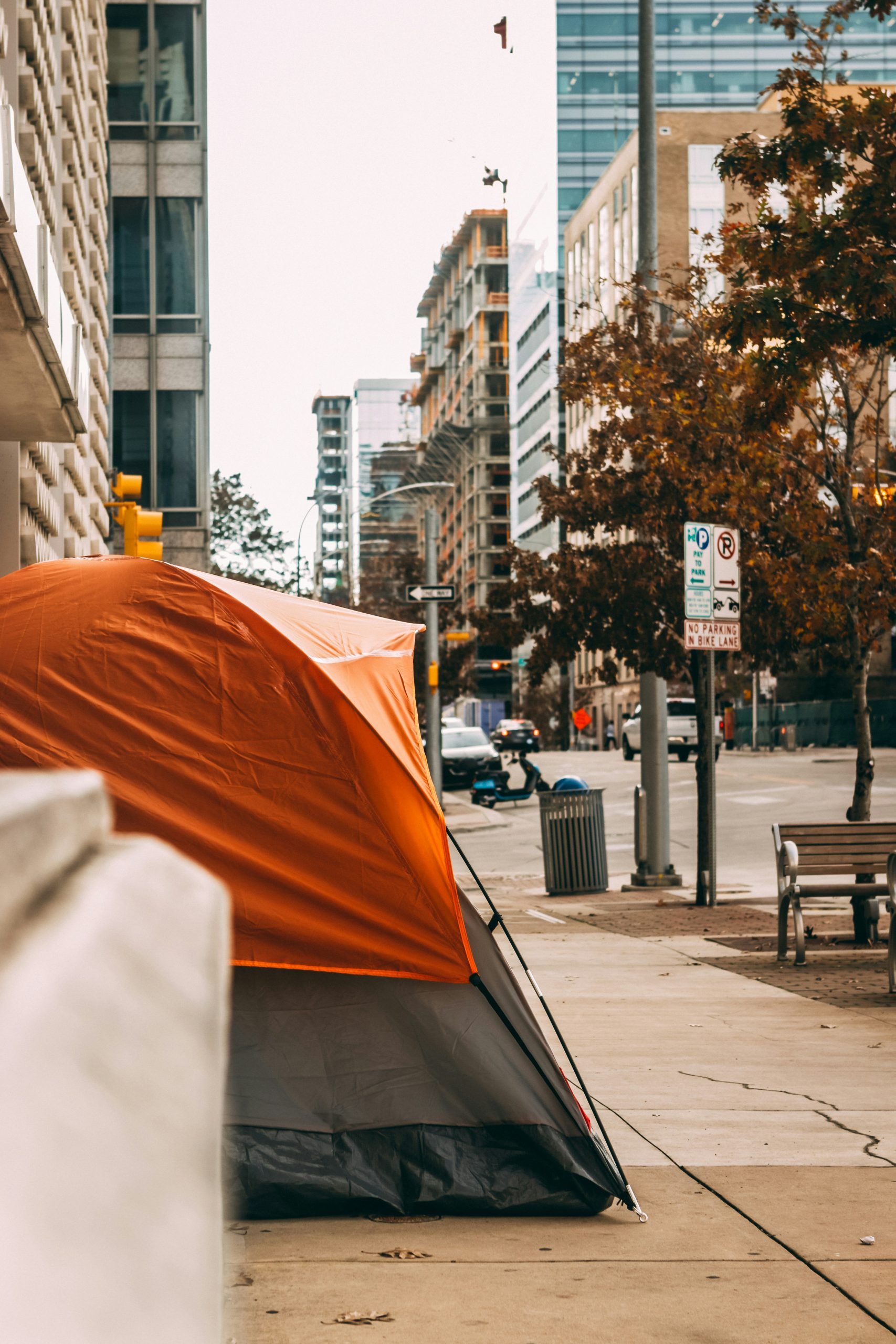
Photo by Milan Cobanov on Unsplash



Full Podcast
Transcript
Note to readers: This video session was transcribed using auto-transcribing software. Questions or concerns with the transcription can be directed to [email protected] with “transcription” in the subject line.
Mary Rowe: [00:00:02] Welcome to CityTalk, the show about what’s working, what’s not, and what’s next for the places we live. I’m Mary Rowe and I lead the Canadian Urban Institute. [00:00:09][7.6]
Corey McCallum: [00:00:14] While the Downtown Eastside definitely does have a highly visible concentrated example of mental health and the opioid crisis, so I think it’s important not to frame this as a problem that’s unique to the Downtown Eastside, you know, or assume that the rest of the country is unaware or not being faced with this. [00:00:32][18.6]
Mary Rowe: [00:00:37] You’ve probably heard of Vancouver’s Downtown Eastside, and not for reasons that make you wanna rush on over and visit. It’s one of the city’s oldest neighborhoods. And there was a time when it was Vancouver’s retail and cultural center. There’s even a Carnegie Library at the edge. But neighbourhoods evolve, and now the area has become synonymous with substance use, homelessness, and the tragedy of a seemingly intractable mental health crisis that is affecting dozens, if not hundreds, of communities of all sizes and shape across Canada. So we’re doing a series of episodes on CityTalk looking at this issue from different perspectives and focusing in on what’s working, what’s not, and what needs to be next to find solutions. It’s really hard to see anything that’s working when you venture into the Downtown Eastside in Vancouver. Large numbers of people congregating along streets and doorways who are clearly struggling with mental and physical health challenges, substance use and addictions, maybe sleeping rough or bouncing from shelter to shelter. But can we find examples of something that is working? Donna-Lynn Rosa is the CEO of Atira Women’s Resource Society. Corey McCallum is Atira’s Director of Outreach Programs. Atira is one of the largest providers of supportive housing to women in Vancouver, and it is located right in the Downtown East side. They are at ground zero. And they’re going to help us discover what is working in the Downtown Eastside. Donna-Lynn and Corey, welcome to CityTalk. Thanks for joining us. [00:02:17][100.0]
Corey McCallum: [00:02:17] Thank you very much. [00:02:18][0.4]
Donna-Lynn Rosa: [00:02:18] Thanks, Mary. [00:02:18][0.3]
Corey McCallum: [00:02:18] Nice to be here. [00:02:19][0.3]
Mary Rowe: [00:02:19] I’m gonna set this up with some general sort of topics because as you know, we have listeners across Canada and some may be familiar with the Downtown Eastside and some really not be. And we have the listeners in the United States who maybe know the Lower East Side in New York but they don’t know the Downtown West Side in Vancouver. So it’s been a well-known face of the opioid crisis for a long time. You guys can tell me for just how long. But people across the country may not understand the intensity of the crisis or the history of it. So can you lay out for us just how severe this has become? I’m gonna start with you, Donna-Lynn, please. [00:02:53][33.6]
Donna-Lynn Rosa: [00:02:54] Sure, thanks. Well, I mean, Corey’s, interestingly, he and his team are on the ground in the Downtown Eastside. I’m joining from that area, from our offices. You know, this is a community, as you said, Mary, that is one of the oldest communities in this area. And while it’s been a tourist attraction, the community that has been built has been built up around people with a confluence of needs. Addictions, mental health. But really, what brings this community together is their ability to support each other and the services that are provided for each other in this community. It is a community where, I can tell you, when I started working here, I would walk down the street, and yes, I would feel uncomfortable, but I’ve never felt unsafe. And it’s a community that embraces you when they get to know you, when they get to see you, when they get to trust you. And we’re actually all here supporting each other, lifting each other up and walking alongside each other so that we’re not dictating what people need in life. We’re here to support and provide services where we can. And mainly, for Atira, it’s women’s resources. So it’s woman, children, gender diverse folks who are fleeing violence. [00:04:07][73.0]
Mary Rowe: [00:04:09] Corey, it would be helpful probably for us to have a bit of a sense of your own personal histories with the space. So tell us how long you’ve been working in the area. [00:04:17][7.9]
Corey McCallum: [00:04:18] I’ve been working for Atira and in the area for 15 years now. Um, I spent a pretty significant amount of time working in SROs, which is single room occupancy buildings, supportive housing. And, you know, really started from the ground up with Atira, um, have seen different looks of the Downtown Eastside in terms of pre-fentanyl to where we are today with the opioid and toxic drug crisis. And, you know, we, although the Downtown Eastside in my duration of working down here has always been a marginalized neighborhood, we definitely have seen an increase in fatal overdoses, folks with more glaring mental health and addiction-related issues that are front-facing in the street, that are not getting support and services that they need on the spot. [00:05:09][51.1]
Mary Rowe: [00:05:11] How many blocks is the Downtown Eastside? [00:05:13][2.2]
Corey McCallum: [00:05:14] I think like the most concentrated would be like six to eight city blocks. I do think it’s important to, while the Downtown Eastside definitely does have a highly visible concentrated example of mental health and the opioid crisis, while we’re talking about this, I think it is important not to frame this as a problem that is unique to the Downtown Eastside, you know, or to not assume that the rest of the country is unaware or not being faced with this. The opioid and mental health crisis is unfolding across urban and suburban rural communities nationwide, which are often less visible, but equally devastating in many ways. [00:05:54][40.2]
Mary Rowe: [00:05:55] Yeah, I mean, that’s why I wanted to talk with you folks, because I feel that we have these challenges at different levels of intensity and scale in communities across the country. Big cities, small cities, small communities, rural communities. I mean no one is immune from all this. But just let me say as a non-Vancouverite who comes to Vancouver twice a year, let’s say, I always walk the Downtown Eastside, but I’ve got to say it was the most disheartening walk I’ve had in a long time. I wasn’t afraid for myself, but I did find myself feeling overwhelmed by the intensity of challenge and struggle that people were obviously having in public space, on city streets. It’s a struggle to try to understand what the hell has gone wrong here that this is so concentrated. And so visibly a failing system. So that’s just my eastern Canada bias coming in. [00:07:00][64.8]
Corey McCallum: [00:07:01] I think, Mary, if I could speak to that, I think some of the shock that some people feel when visiting the Downtown Eastside can reveal more about — not claiming that this is your stance per se — but it reveals more about society’s distance and sometimes apathy towards people living in extreme marginalization, rather than the true scope of the crisis. Reducing the issues to what is visible in the downtown Eastside risks oversimplification, reinforcing stigma, and missing the broader and systemic failures that fuel this nationwide emergency at this point. [00:07:42][41.2]
Mary Rowe: [00:07:43] No, no, listen, I’m agreeing with you that it’s very clearly a systemic failure. Very clearly. You’re not gonna blame anybody individually for what you’re seeing there. But for someone who is invested in how we make cities a better place, let me go to you, Donna-lynn, I mean, Atira has zeroed in on a particular set of services and supports that obviously you have experience to suggest are making it better for people. There’s obviously a confluence of many issues, including mental health challenges, substance use, drug abuse, drug addiction, homelessness going on here. When you look at your particular work in that community, how do you prioritize which do you tackle first? [00:08:24][41.6]
Donna-Lynn Rosa: [00:08:26] That’s an excellent question. And I will say, you know, Mary, first of all, there’s a little bit of sensationalization going on across the country around the Downtown Eastside. I should say that. So when people come in, they’re expecting the worst. Really, we should say, I mean, some of it is for various fodder and political ploys and all those things. The fact of the matter is, we know people need housing and we know that people need services. So we’re here to develop housing and to provide housing, whether it’s single room occupancy, whether it’s shelter, whether it’s supportive housing, whether it’s moving into more permanent housing. Our goal is to walk with folks along their journey to find them the right housing, but you cannot have housing and be successful in community if you don’t have services. And so the services that are here in the Downtown Eastside help people to get through their day and move to whatever their hope is. You said something about this being, and Corey has mentioned, that this isn’t just a Vancouver Downtown Eastside issue. This is across the province, it’s across the country. One of the challenges we have is that other municipalities haven’t necessarily kept pace and they haven’t been offering the services. This is a grossly underfunded sector. And it’s not just in terms of the housing. It’s in terms the mental health supports and the other wraparound services that are needed. And I will say, I’ll just add to that, we know that Atira went from a five-room house in Surrey where we supported women fleeing violence because we knew that there was no place, nobody supporting women alone. And we’ve grown to over, at our highest, we’re over 3,000 units. And we’re not even coming close to meeting the need. [00:10:21][114.9]
Mary Rowe: [00:10:21] Let’s talk for a minute about those things, because I’m hearing you about this point about underfunding. I mean, we have this all the time at CUI, that municipal governments are challenged by situations that actually are not all of their doing, that there are multiple jurisdictions that are responsible for aspects of our life together and if the federal and provincial governments aren’t as engaged and aren’t is committed financially then it just flows downstream, and suddenly it’s in your hands with the municipal government that you have to deal with all that. I mean, we saw that during COVID, and that’s when I first got to know you, Donna-Lynn. You were working as the director of the Parks Department, or what was your title? You were what? [00:11:02][40.8]
Donna-Lynn Rosa: [00:11:03] General Manager of the Park Board. [00:11:04][1.4]
Mary Rowe: [00:11:05] But you were faced with encampments, and the same point that Corey is making around these manifestations of mental health, we see the same with encampments. There were encampments that were across the country. They’re in communities of every size, but you had a couple of extraordinary ones. And you were both, I think, Corey, you worked on the relocation of people out of encampments too, am I right? [00:11:27][22.2]
Corey McCallum: [00:11:27] That’s correct. [00:11:28][0.3]
Mary Rowe: [00:11:29] To me, that was a really important illustration that just for the benefit of our listeners, encampment are naturally occurring places where people choose to pitch a tent or sleep rough, and they can get quite large. So in the case of the one at Oppenheimer Park, I think, is that the one that was the biggest? [00:11:48][19.1]
Donna-Lynn Rosa: [00:11:49] Oppenheimer was big. Strathcona was bigger. It hit about 500 tents at its largest, and then CRAB Park came after that. It was basically the same folks changing from each one. But essentially what happened at Strathcona was because COVID hit and because there was some debate about whether people would be safer inside, safer outside, there was a lot of back and forth. And for the first time ever, the province, the municipality, and the elected Park Board, the three levels of government, came together, signed a memorandum of understanding, and agreed to who was responsible for what. And so that forced the staff, once the political folks signed this MOU, the staff came together and then had to deliver. And the number one priority was to keep people alive. The number two priority right up there was to do this with dignity and move people into spaces that were appropriate. Now, what happened was we had to move people into spaces and the city and the province work together to get things like old hotels and move quickly. And it wasn’t the regular process that you would use to triage to make sure that people were in the right spots that fit the needs, the mobility needs, the wraparound service needs, and even the community needs. You know, not everybody should be in one community or another. And this is what we do with the province to make sure that people are properly fit into their spaces. But what Corey’s team was doing was going into the park, whether it was handing out water and saying, hello, hey, somebody cares about you today, or it was, hey let’s pack your stuff, we got you a new place and you have a key tonight to lock your door. That’s what his team was doing. [00:13:33][104.1]
Mary Rowe: [00:13:34] And it really is person by person by person, right, Corey? It’s got to be, I mean, this is what I’ve learned walking, walking into communities with folks like you. I just learned that you know everybody’s name. You’ve got a sense of what everyone’s circumstance is. [00:13:51][16.3]
Corey McCallum: [00:13:51] Wwll our time at Strathcona Park, we spent a significant amount of time in that encampment. Our teams were there every day 24-7 for about almost five months. And yeah, we did get that opportunity to get to know all of the individuals there, individual needs. We got a really great opportunity to see the side of the encampment that probably wasn’t seen by a lot of folks who would be outside of a community like that, that it really was a community. It had its own leadership. It had its on hierarchies that, you know, for better and for worse worked for that community. And the community at that time, we had the benefit of after some time of relationship building, really embracing us as part of it. And so, yeah, it is very much case by case, meeting people where they’re at and delivering services to the best of your ability that are based on the individual needs of ax person. [00:14:53][61.7]
Donna-Lynn Rosa: [00:14:54] Mary, can I just add to that, that while the government was getting their stuff together with the MOU, the critical part of the success of treating people with dignity and moving people indoors through Strathcona Park was the partnership with the not-for-profits, and in this case, Atira. The partnership with the folks who are actually in there. Government can write all the MOUs and all the policies and all this stuff they want to do, but without people building relationships like we do at Atira and like the other not-for-profits do, none of this is gonna work because there’s no trust. And that’s where Corey and the Atira team came in and built that trust in order to make anything work. [00:15:32][37.6]
Mary Rowe: [00:15:34] So let’s talk about the funding piece, because the suggestion, I think, was that people may think, oh, this is isolated. Oh, well, that’s Vancouver. That’s the Downtown Eastside. But in fact, we won’t have a listener, I’m sure, that won’t be able to identify an area that they know in their city where someone is sleeping rough or some kind of an experience or proximity they’ve had to someone who obviously has a mental health challenge and may be in and out of a shelter system or something like that. So is it alignment that would bring the resources to bear? What do you think, what do we need to do to get that funding challenge addressed? [00:16:10][36.1]
Donna-Lynn Rosa: [00:16:11] Number one, let’s get the ego.sOut of the room, and let’s get the, “hey, elect me next” out of the room. Like, if we can get that mentality set aside and actually centre the human being, centre the fact that this one person deserves dignity, this one person deserves a shot, and I do not have the right to tell that one person what their definition of living is within the scope of, you know, the law and stuff. But ultimately, we have not centred the people in this. We have centred government, we have centered policy, we have centred politics way too much, and it’s all ego-driven. And if we can drop the egos, we can get the right people to the table. Corey, I’m sure you have even more insight on that. [00:16:59][47.9]
Corey McCallum: [00:16:59] Well, I mean, something that I hear a lot and we hear it kind of on the news. And it’ll be like, what are we going to do to fix this? Like what’s, you know, how are we gonna fix this problem that we see? And, and I think that that’s a mistake. Like not everybody’s idea of being successful or having a successful outcome might not look the same. So when we walk the Downtown Eastside or East Hastings and the 3 or 200 block and we’re like, oh my goodness, like this is out of control. But what it actually is, is you’re seeing a group of people that are probably connected to services, probably have health teams that are following them, probably have access to housing and advocates and resources and food, and we’re ensuring that people are gonna stay alive or hopefully live a full life, or live long enough to be able to access services that will be pivotal in their own life experience and make a choice if they want to. [00:18:00][60.2]
Mary Rowe: [00:18:01] But Corey, if you take what you’re experiencing in a concentrated area in the Downtown Eastside and you come into Montreal or you come in to Toronto or London or Peterborough or Edmonton, what I observe when I’m in those cities is I don’t see the same level of intensity and concentration going four or five blocks. But what I might see is a clustering of 5, 6, 10, 15 people in a gathered area, and what we will hear from people is that it means that the businesses can’t function on that street, or, and as we can see, governments are responding in a way that you would probably suggest is inappropriate. They are reflexively responding because school kids are passing by and the parents don’t feel comfortable that the kids have to be exposed to open drug use. So this is a challenge in urban life generally. How do you actually make room for multiple uses, different kinds of users, different types of dwellers, and how do we have a kind of set of accepted norms that make it feel okay? So what would you say back to that neighborhood, Corey, that is saying, wait a second, I can’t get my kids into school, or I can’t go and use that corner store, because I have to go through a gathering of folks whose focus is not on, you know, buying a quart of milk at the store. [00:19:31][89.6]
Corey McCallum: [00:19:31] Yeah, it is a very good question that I don’t necessarily have the answer for you. I think that, for example, for a neighborhood like the Downtown East side, I’ll use an example like Oppenheimer Park, which is across the street from our office. The City of Vancouver has partnered with our group to have us staff the washrooms there, which is visited by a wide array of people. There’s a children’s park right behind it. And so with that partnership, we have three staff on, and we also have 15 to 20 peer workers from the community who oversee the safety of that washroom and ensure it’s, you know, that folks are able to access that space safely. And I think it’s creative thinking like that, reaching out to the communities to find solutions around issues like the one that you raised. Because when we’re looking to the community, they will have the words, the body language, the know-how of how to approach individuals to communicate to them, like, hey, you know, let’s maybe clear this space out so that these families can get by. And I totally hear you that it’s a complex situation, but I do think with creative thinking and collaboration between government and non-profit service providers, you can come up with creative solutions for those complex situations. [00:20:53][81.8]
Donna-Lynn Rosa: [00:20:54] If I could add too, like, let’s be crystal clear that the majority of folks in supportive housing present no threat to the community, to the staff, to anybody, like the majority. There are a few, just like any community, and, you know, it really is, most of the incidents that we find are happening, are happening where there’s chronic underfunding, where there’s aging out facilities. When people don’t have a place to be inside that’s temperature controlled, so they have to go outside, they’re congregating. The Downtown Eastside per capita has the lowest amount of access to green space. You have Oppenheimer Park and you have CRAB Park basically, and then one of the parks we have is all concrete down here, Pidgeon Park. So without access to greenspace, you’re now pushing people into a location and they end up on the street where they gather as community. But again, part of that is the chronic underfunding where we’re putting people in old, old, old buildings and there is no air conditioning in these buildings. There is no place for people to ventilate in these building. [00:22:06][71.5]
Mary Rowe: [00:22:08] I mean, this, as you say, underserved building, underserviced buildings, and no place to go. And here’s another little piece of the puzzle, which I’m interested what your views would be. The Downtown Eastside, like key areas in other cities, also is where there’s a concentration of services and supports for people that are experiencing some of the challenges that folks experience in that circumstance. And there are folks that will say, well, why don’t we distribute those services more broadly? Why are they concentrated in the downtowns? This is true of downtowns across the country. Should we be looking at distributing services across other neighborhoods? What’s your perspective on that? [00:22:48][40.3]
Donna-Lynn Rosa: [00:22:48] Ultimately, I don’t think we disperse what’s in this area. We still need this amount. We just need to add services elsewhere because there’s services needed. People move to this space because of the services, but they’re also staying home and people should be allowed to stay home. Sorry, I was a little passionate about that one. [00:23:05][17.0]
Mary Rowe: [00:23:06] Passionate’s allowed. Passion is good. I mean, I guess that’s the thing. It shouldn’t be a zero sum game. We shouldn’t have to say, Oh, well let’s make fewer services available. Of course not. But I feel with encampments, and I observed this through COVID, there’s this wonderful term in urban planning called desire paths. A desire path is you design a park and you make beautiful areas to sit and you have pathways and the landscape architects and the designers come up with this beautiful design and maybe they talk to people and say, oh, we might make it this, we might make that. They build the darn thing. And for six months they watch and they find out after six months that actually nobody uses that path. They all take the grass. It’s called a desire path. And I feel like encampments are a form of desire path. They are people telling us that this is the choice I’m making and where I want to be located. I want the attributes that an encampment can give me. And Corey, you just described it beautifully when you were talking about Strathcona. They self-organized, they had a sense of community. Donna-Lynn, you always remind me there’s an elaborate network of mutual aid in the Downtown Eastside that you want people who come in to suspend their judgment and be able to see what is organically forming here as people do help each other. And I think those are important takeaways, that these are fundamentally different forms of community. I guess what we’re struggling with is how do we address the underfunding issue? How do we adjust the fact that there should be better facilities? You just said one, more greenspace, more options for places to go so that it doesn’t then become this concentration of what some people would find overly bleak. [00:24:54][108.6]
Corey McCallum: [00:24:56] I’d like to add into that purpose-built housing as well, housing that is built purposely to house complex folks. For example, a unit that has its own drain in it so that if the sprinklers do go off, the four floors underneath it don’t get flooded out. So just, again, creative solutions to that. And you mentioned something that’s actually really important is these encampments, they offer a community that an SRO won’t be able to. Although there may be individuals that the folks there do connect with, Donna-lynn mentioned they’re hot, they’re old, they’re pest-ridden. They have various long-standing histories within Vancouver. As well they come with rules that sometimes people do not want to, maybe not even do not want to, but their lifestyle, their needs, do not co-align with those rules systems. So they find themselves being evicted from one provider, then the next provider, then the next provider, and then they find themself possibly living in an encampment where they’re able to have that autonomy to live their lifestyle. [00:26:07][71.7]
Mary Rowe: [00:26:08] I’m wondering as we try to round this out, we know that we need some additional funding, we need jurisdictional alignment, we need higher degrees of trust with organizations. And then I think we need some sense of hope that there’s another alternative, another path. Tell me what gives you hope, Corey. [00:26:27][18.4]
Corey McCallum: [00:26:28] You know, I’ve been in the field for a while now, and in my times of trying to seek hope or understanding, I kind of realized that addiction, mental health, poverty, marginalized populations, have been here since before I was ever here and will be here long after I am gone. And so with that, I found in a way, rather than trying to… Figure out how can we find an accepting space within ourselves to realize that this is a part of our community, this is part of our society, and always has been and always will be. So finding that space within myself to open my heart to individuals who are heavily marginalized by our society and find a space for them where they do exist as they are here and now, versus trying to figure out how we can get rid of this or how we fix them is to really hold space for individuals who are marginalized by our societies, whether it’s through mental illness, addiction, poverty, trauma, or all of the above. Find a space where that does exist and I think that as as jarring as the Downtown Eastside can be for some people who don’t spend time here, that’s what this neighborhood is, is this is a space and a place that is carved out for people who are marginalized by our society. And so that is what kind of brings me hope is just finding that space within myself where there is no cookie-cutter answer. Let’s see what we can do to get services to people who need them and have them on standby for people who don’t need them yet, but may want them in the future. [00:28:16][107.9]
Mary Rowe: [00:28:18] You know, I often say that cities are fundamentally about empathy. We throw ourselves in together. It’s an Indigenous concept as well, Donna-Lynn, that we are interdependent on one another. And so the more that we remind ourselves that we are interdependent and that our proximity and our adjacency puts us into company with people that are not like us and have different circumstances than we have, but that we build our capacity to have empathy for one another, and somehow together we find a shared path. So with that note, thank you for joining us to talk about a very complex and also demanding, but also, at many ways, poignant and heartening when you talk about the strengths and assets of the Downtown Eastside and what the people are bringing there. The organizations, the people that live there, the people that work there, but also the people that find themselves there and have their sense of attachment and community. So thank you for joining us. Corey, delighted, really pleased to meet with you. Thank you for taking the time. And Donna-Lynn, lovely to talk with you too in this new role that you’re in and for us to hear about the long-term efforts that Atira is making to provide these kinds of supportive communities right in the heart of the Downtown Eastside. So thank for joining. [00:29:37][79.2]
Corey McCallum: [00:29:38] Thanks for having us. [00:29:39][0.7]
Donna-Lynn Rosa: [00:29:39] Thank you. It’s a pleasure. [00:29:40][0.7]
Mary Rowe: [00:29:42] CityTalk is a podcast from the Canadian Urban Institute produced by Antica Productions. Our producer is Kevin Sexton. Our executive producers are Laura Regehr and Stuart Coxe, and Jack Bailey mixes the show. If you’re enjoying this show, please give us a rating and review it in your podcast app. You can also follow the Canadian Urban Institute on YouTube to find a video version of this show and other content like it. I’m Mary Rowe. We’ll be back in two weeks for another episode of CityTalk. What’s working, what not and what needs to be next for the places we live in. [00:29:42][0.0]
5 Key
Takeaways
1. Vancouver’s Downtown Eastside Reflects a National Crisis
The guests emphasized that while the Downtown Eastside is a prominent example of homelessness, addiction, and mental health challenges, these issues are not unique to Vancouver. Similar crises are unfolding in urban, suburban, and rural communities across Canada. The visible concentration in this neighborhood should not obscure the systemic failures nationwide or reinforce stigma, but rather prompt a broader conversation about root causes and solutions.
2. Mutual Aid and Community Resilience Are Essential
Donna-Lynne Rosa described the Downtown Eastside as a deeply interconnected community where residents support one another, and trusted relationships with service providers are fundamental. Both panelists stressed that real progress comes from “walking alongside” people, not dictating what they need. Despite challenging conditions, the neighborhood embodies mutual aid and resilience, lifting each other up and offering support to society’s most marginalized.
3. Underfunding and Misaligned Systems Impede Solutions
The sector remains chronically underfunded—not just in housing, but in mental health and wraparound services. Donna-Lynne Rosa argued that political egos, jurisdictional silos, and a focus on government or policy (rather than the person in need) have slowed progress. She called for more resources at all levels and for systemic reforms that center human dignity and “drop the egos” to focus on practical, person-centered interventions.
4. Creative, Community-Led Solutions Work Best
Corey McCallum highlighted successful examples like the collaboratively managed washrooms at Oppenheimer Park, staffed not only by Atira employees but also by neighborhood peer workers. Such approaches, he noted, rely on creative thinking, deep engagement with local communities, and flexible, adaptive responses rather than rigid, top-down policies. Both panelists said that encampments often function as organic communities—”desire paths”—showing where unmet needs draw people together.
5. “Fixing” Is Not the Goal—Meeting People Where They Are Is
Both speakers challenged the notion that homelessness and substance use are “problems” with clear, universal solutions. Corey McCallum underscored that success looks different for each individual. Solutions should not be about “fixing” people, but about holding space for them and supporting their choices, ready to provide services when and how they are needed. This approach, they argued, is rooted in empathy, interdependence, and the recognition that marginalized people will always be part of cities, deserving respect, dignity, and a place in the community.